


My FB feed was an endless stream of tribute posts on the day Resil Mojares died, both from institutions and from my personal connections. I took it for granted that everyone knew him and that we were all one in our mourning.
The day after, I saw someone on Substack say they had only found out about Mojares because of all these posts. Then I asked some friends I happened to be having lunch with, here in Davao, whether they knew him. Only the Cebuano did.
(In case you are one of them: Resil B. Mojares, historian and literary scholar, founding director of the Cebuano Studies Center, National Artist for Literature, died last September 5, a day after his eighty-third birthday.)
Before I begin my own forty days of mourning, let me write this for those who only heard of him because he died. The cuarenta dias is how our folk Catholicism processes grief: the novena at the first days of haya, and then the count to the fortieth day, when the family gathers again for a Mass — forty days as Christ had forty days before he ascended. It is the immediate family’s rite, and I have no claim to it. But I think they’ll forgive me if I do a DIY student’s version of it. We also need to mourn.
I met the professor exactly three times: at a talk when I was in my teens; then in the 2018 Cebu Lit Fest, when he autographed the stack of his books I’ve been collecting; and once when we both happened to be working at the Coffee Bean & Tea Leaf across Landers. And yet I am, at this moment, experiencing grief. I think this is because I have spent the past two decades reading his works and wrestling with his ideas. That engagement has only increased as I grew as a scholar. Right now I am in the middle of preparing a conference talk whose approach is inspired by his essay “The Islands According to Pigafetta.” I had no personal connection to him. I still consider him one of my most important teachers.
There’s a certain generosity in the type of writing he did. What I’m doing here is a bit selfish; I need to make sense of this loss, and writing in these little corners of the internet has always been how I made sense of things. Mojares’ books, in contrast, feel like they were written for us, his readers. His prose was crafted to teach, not to display virtuosity or erudition — though he certainly had both. Prose that clean is expensive; it costs more skill, more talent, and more revisions than showing off does.
I’m not the right person to talk about how good a man he was. I did not know him personally — though many of the personal FB posts attest to how unassuming and approachable he was. I’m also not the right person to talk about his legacy, and I don’t need to: in the next few weeks the biggest names in Philippine academia and literature will be publishing their homages. What I can do is introduce you, dear reader, to Prof. Mojares — in case you have only just heard of him — and try to convince you to become his student too. We can be classmates.
If you are an Alex Eala fan, you already know the feeling. If you’re one of the few weirdos who don’t support Alex, Manny Pacquiao or Hidilyn Diaz will do. Mojares’ works are the scholarly equivalent of what these athletes achieved: pound-for-pound world champion, gold medalist, generational talent. You don’t have to take my word for it. Caroline Hau, writing about Rizal’s novels, reaches for Mojares’ Origins and Rise of the Filipino Novel — “his pioneering and comprehensive study of the novel form” — and builds her own argument on top of it.1 That is what it looks like when one scholar’s work becomes the ground other scholars stand on.
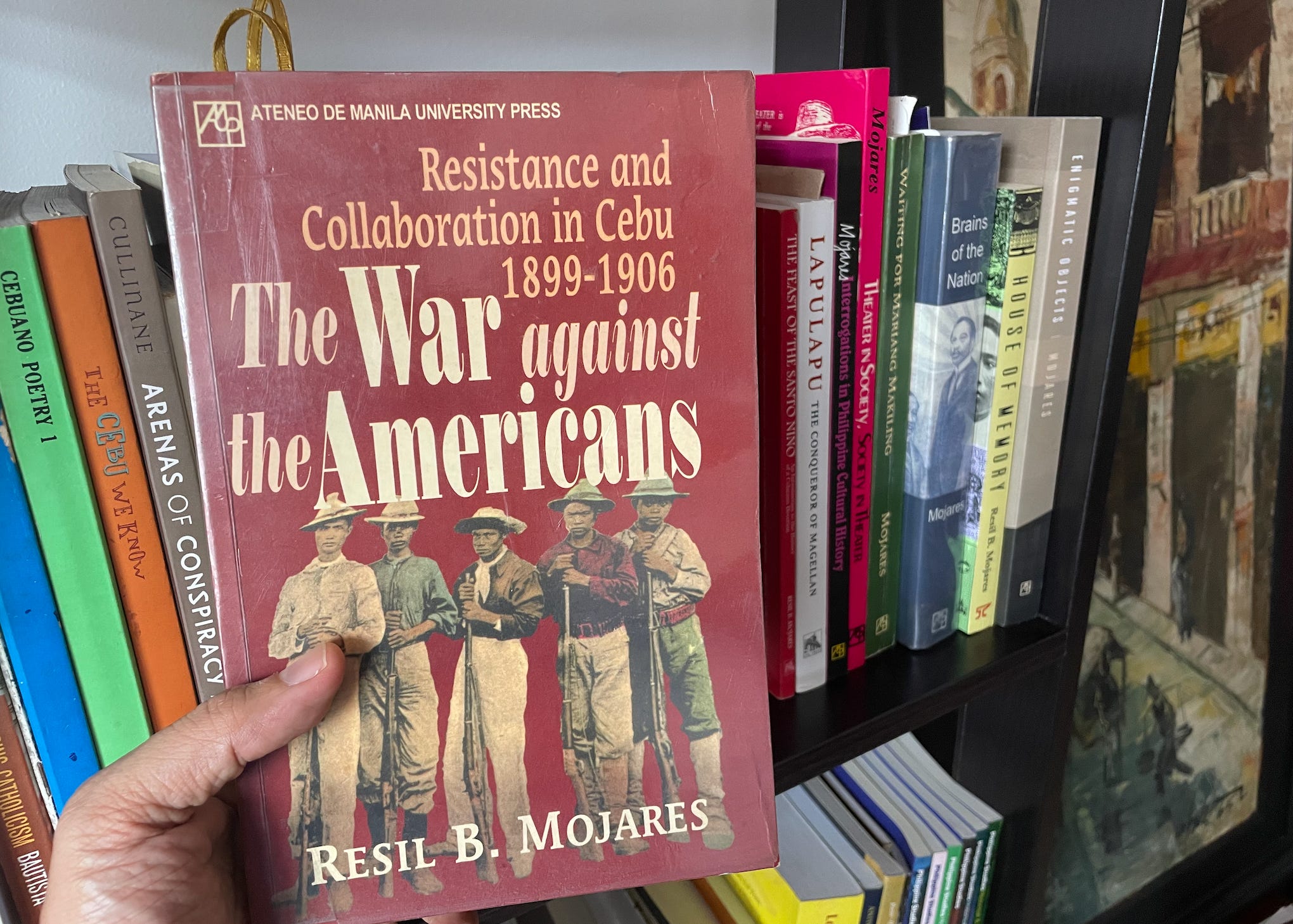
The best entry point, in my opinion, is The War Against the Americans. It isn’t too long and it deals with concrete events — plain history is easier to enjoy than cultural history, which is what he’s known for. It is also a single sustained work rather than a collection of essays, so you get to watch him build one argument from beginning to end. And if you live in Cebu, there’s a richness waiting on the other side of this book. When you get stuck in traffic in Gen. Maxilom, C. Padilla, M.J. Cuenco, and many other streets, you’ll at least know the story behind the name you’re idling under.
House of Memory is easier to read, being a compilation of short essays of the kind you could run in a newspaper, or in a magazine you’d find in a dental waiting room. But this is like watching Hidilyn Diaz’s deadlift.2 Her deadlift is certainly world-class. To see her greatness, however, you need her snatch and clean & jerk, at her peak. I also wouldn’t start with Brains of the Nation unless you’re a humanities scholar. Just as the best way to appreciate Diaz’s lifts is to do some Olympic lifting yourself — in Crossfit, say — the best way to get ready for Mojares’ magnum opus is to do some scholarship, or at the very least to read a good number of scholarly works.
We now have a growing number of scholars studying and publishing on Philippine history and culture, and the best of them are world-class in their rigor. What is rare — here and globally, across disciplines — is rigorous scholarship that is also deliciously written.3 This is somewhat a matter of taste. Read enough academic papers and you develop a tolerance for the convoluted and the baroque; after years of immersion in academic slop it becomes second nature to write in the jargon of one’s discipline, for deadlines instead of craftsmanship. For most of us, getting anywhere near Mojares’ serene lyrical clarity while also delivering novel ideas takes enormous effort and many revisions.
What he chose to work on is perhaps even more important than the quality of his work. I only appreciated this after getting an idea of the overall spread of Philippine scholarship, especially its gaps and concentrations. Mojares is known for championing “regional” or “local” scholarship, for choosing to work in the “peripheries” rather than in the center. I’m using those scare quotes to highlight how deeply-rooted this problem is: that even the framing of the solution inherits what it tries to solve. It’s a mirror image of the national language problem. Everyone is taxed, yet no one gets taught their mother tongue — except one language group. That the same shape shows up in scholarship and in language tells you this is not a conspiracy to favor one culture over the rest. It is a consequence of the kind of nation-state we happen to live in.4
Here’s my reading. Mojares was simply being a good scholar in his choices of problems to solve. He directed his limited time and his substantial talents on questions at the intersection of what others tended to neglect and what he uniquely could tackle. His work on Cebuano history and culture — books like The War Against the Americans and the establishment of the Cebuano Studies Center — were precisely inside this intersection. Brains of the Nation shows that his choices lay in the gaps, and the “local” or “regional” was simply one of these gaping holes in Philippine scholarship. The choice of profiling three neglected ilustrados — the first too conyo, the second too white, and the third too Dionysian for the needs of the nation-state — was a gap of the same kind. And the concluding part of the book, “The Filipino Enlightenment,” fills a bigger one. Our histories of the colonial period tend to be polemical: victimhood, struggle, and eventual victory on one side; elevation from precolonial savagery by the civilizing benevolence of the West on the other. Mojares wrote neither. He wrote a history of Western thought in the Philippines — how it arrived, who took it up, what they made of it — in the usual Mojares way: rigorous, patient, no grievance anywhere in it. Filomeno Aguilar ends his latest book — which I wrote about here — with an aspiration:
Memories of past colonial injuries, which have their own histories, need to be finally uncovered, mapped, confronted, accepted, and forgiven. With the healing of historical trauma and the acknowledgment of historical truths, it will be possible for the twenty-first century to produce a new Filipino narrative of the Spanish conquest, one not reliant on primordialism.
Our sensei had been working on answers long before Aguilar articulated the problem.
If you’ve never read Mojares, I should point out that this combative voice you’re hearing is mine, not his. I complain about how this country distributes its cultural resources, the way someone who came of age in the flame wars of the early internet forums would. Across all his books, in two decades of reading, I have never once caught our teacher complaining. He just kept working on solutions. In an interview with Palm Grass Heritage Hotel, where the obvious move would have been to lament the collapse of Cebuano literature and cinema after the early twentieth century, he mentioned instead that he was working on a book of lost Cebuano words.
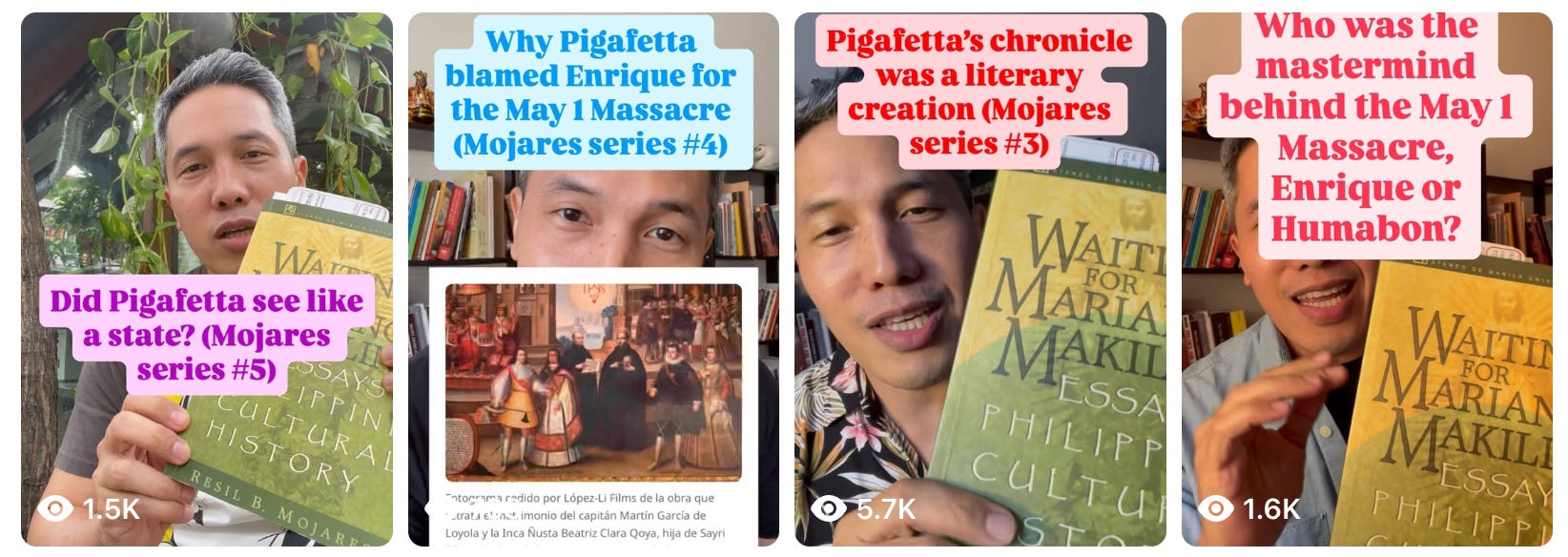
There is a role for us internet brawlers, I think. The works of our maestro are too valuable to leave inside academia. There will be symposiums and memorial lectures and festschrifts in his honor over the next few years, and there should be. Out here, though, where the rest of us actually read, the shelf is empty. Scroll around and you’ll find video explainers on Bourdieu, on Nietzsche, on Philippine mythology, on how to reclaim the Filipino spirit in the Instagram kapwasphere — and almost nothing on Mojares. That’s a gap, and by now we know what we should do with gaps. So instead of complaining, I’ve been trying to fill it myself: talking about his works on video, in street Cebuano, out here in the open internet. It’s an amateur’s attempt. It would be nice if more of us were doing it.
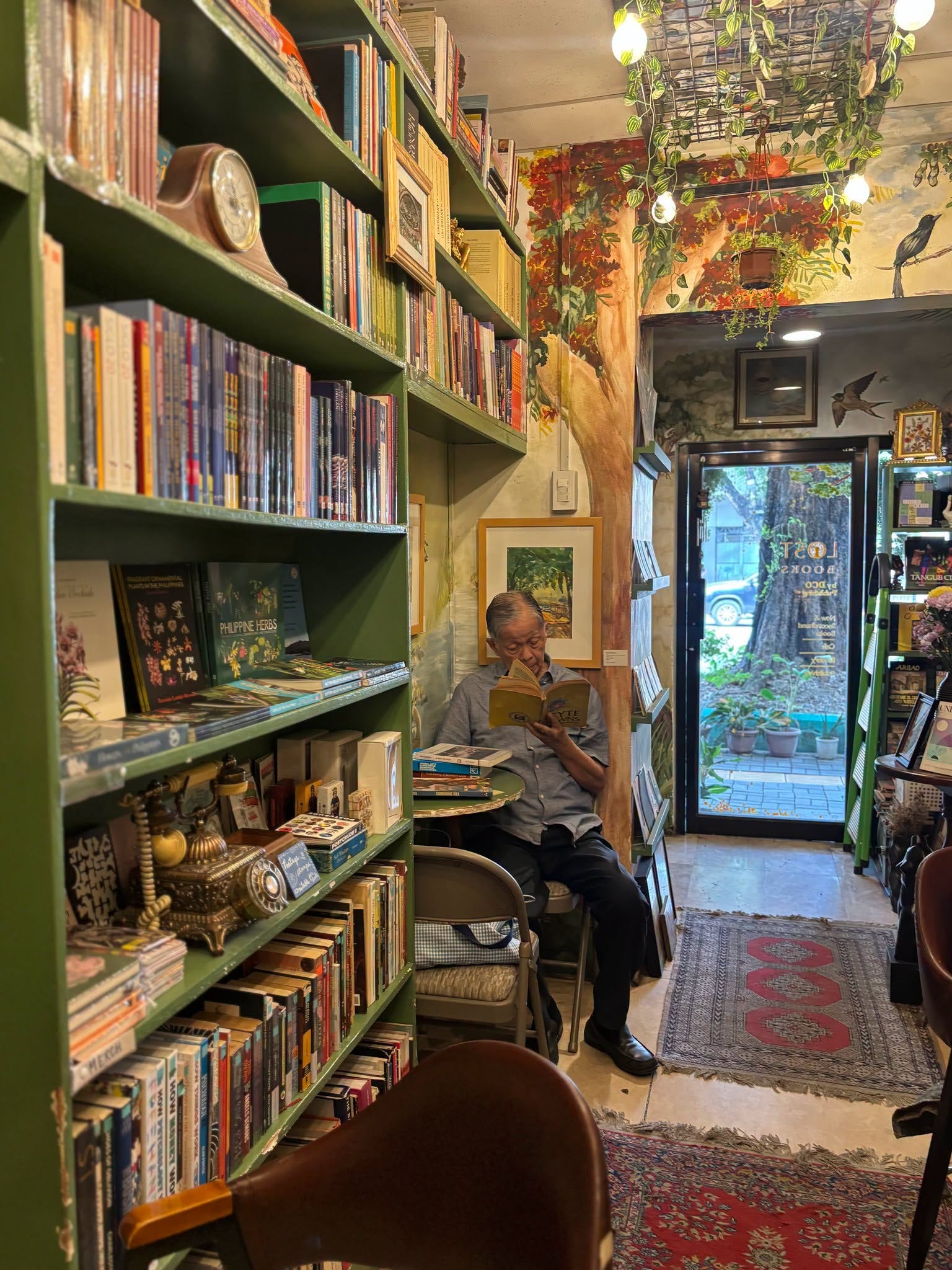
My suggested enrollment method is to visit Lost Books or Palm Grass and pick whichever Mojares book resonates with you. Trust your gut over my recommendation. If you're not in Cebu, you can order from them online. Both stock his books, and both have been keeping him present in the city: Palm Grass holds hours of footage from an interview with him, released gradually as short videos to accommodate our attention spans. He visited Lost Books a few days before he died. Support spaces like these.
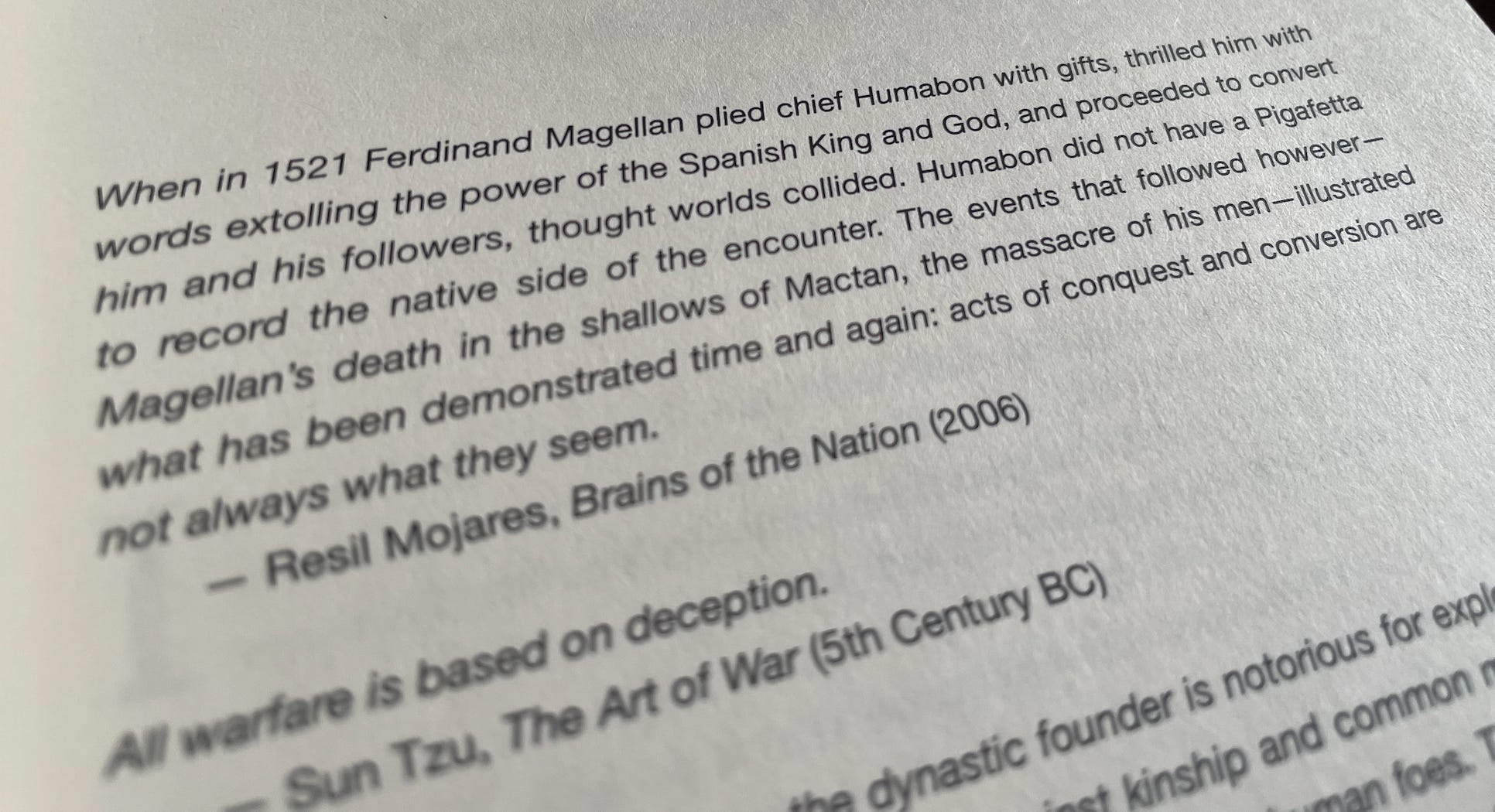
If you’re currently broke, a number of his academic articles can be downloaded. My bias is “The Islands According to Pigafetta,” of course: it’s central to the conference talk I’m preparing, four of my Mojares videos riff on it, and my novel that retells 1521 opens with an epigraph from Brains of the Nation. I put it there as a kind of challenge to myself — to read past Pigafetta through anthropology, and to build a sixteenth-century Sugbo as thick with cultural detail as Europe usually gets in books about Magellan. If the novel never reached you in this world, Sir Resil, I sure hope to God that it isn’t banned in heaven.
I feel like I should hold off on the Mojares video series until after the cuarenta dias. In the meantime, I’ll be rereading his works and praying for the eternal repose of his soul. Classes will soon resume. I hope to see you then, classmates.
Caroline S. Hau, Necessary Fictions (Ateneo de Manila University Press, 2000), from her chapter on the Noli.
Powerlifters, relax — the deadlift is a contested lift in your sport. It just isn’t one in hers. For an Olympic weightlifter it’s an assistance movement, training for the lifts that count. Which is roughly what a newspaper column is to a scholar.
This is my translation of “lamî paminawon,” which is how I would describe Mojares’ prose.
Neo-animism helped me see this. For a more conventional account of the same mechanism, see James Scott’s Seeing Like a State.
Thank you for writing about him and his works. I'm hoping I'll find some books of his in the ongoing Manila International Book Fair.