

This is the first draft of my contribution to a collection on “Bayaniverse as Philosophy.” As always, I work in public hoping to get the benefit of live thinking: correction where I am wrong, resistance where I am unfair, better sources where I am thin, and sharper language where I am circling something but not yet saying it well. Treat this, then, not as a finished argument but as an argument being tested in the open. Comment below or email me at sugbu@corazo.org
“Napakadakilang bagay ang katotohanan pero hindi ito palaging epektibo sa pamumuno. Kailangan pantayin ang timbang. Sa statecraft, ang mahalaga ay ang layunin.”
[Truth is a magnificent thing, but it is not always effective in leadership. You need to balance the scales. In statecraft, what matters is the objective.]
— Jericho Rosales as Manuel Quezon in Quezon (2025)1
Introduction
On October 23, 2025, at a post-screening Q&A in Makati, a direct descendant of Manuel L. Quezon stood up and accused Jerrold Tarog and Jericho Rosales of desecrating the memory of his grandfather. Enrique “Ricky” Quezon Avanceña did not mince it: “Hindi niyo alam ang ginawa niyo. Dahil kayo, gusto niyo kumita ng pera, gusto niyo sumikat, sinalaula ninyo ang alaala ng isang pamilyang nag buwis ng buhay”—“You don’t know what you’ve done. Because you wanted to make money, because you wanted fame, you defiled the memory of a family that gave their lives” (Roque, 2025, para. 11; translation mine).
Tarog’s film gives Avanceña plenty of ammunition. Quezon’s rival Aguinaldo — the only man with the revolutionary prestige to challenge him in the presidential election of 1935 — has his farmstead confiscated, his pension withdrawn, his rally in Malolos sabotaged by Quezon’s own sergeant-at-arms. Ana Ricardo, whom the film presents as a woman Quezon married during the revolution, is abandoned when ambition summons him to Manila.
Avanceña’s protest is understandable, but it rests on a category error worth naming at the start. He treats the film as biography — as a claim about his grandfather as a person — when the film is doing something else. Quezon is making an argument about power itself. The man on the screen is the case the argument runs through, not the argument’s target. To see this, you have to be willing to read the film the way you would read a novel or a treatise: as a thinker working on a problem, not as a verdict on a corpse.
This chapter takes that approach seriously. I argue here that Quezon is a work of philosophy, and that what it knows — about power, truth, and the audience whose attention, support, and reverence are the sources of this power — is more sophisticated than either its critics or its admirers have so far credited. The framework I’ll use to show this is one I developed and later used to write my own work of historical fiction about another man of power, Rajah Humabon of 16th century Sugbo. Rajah Versus Conquistador (2025) and Quezon came out in the same year and ask — across four centuries of our history — the same question: what kind of man becomes king, and what kind of culture molds him?
The Three Epistemologies
Over the years, I have noticed a pattern. The politician working a room, the kingpin in my high school, the big-shot CEO — each of them, encountered at full intensity, produced the same dissonance before I could name it. They were operating by rules I was never taught, optimizing for something I was never told was the goal. The vocabulary I instinctively reached for was moral: corrupt, evil, without conscience. That vocabulary is not wrong, exactly. But it was incomplete, because it places all the explanatory weight on character and none on how they see the world and what they fundamentally want.
To see what I was missing, we need a word that usually lives in philosophy seminars: epistemology. If knowledge is a map of the territory of reality, then epistemology is the style of making the map. A scientist and a prophet can look at the same flood and produce radically different maps — one tracking rainfall and watershed data, the other reading judgement and mercy into the water. Neither map is useless; they were made for different purposes, with different tools, for different audiences. The question is not which map is true, but each map’s purpose. The map is never the territory, but each useful map necessarily represents aspects of the territory.
When people navigate the territory of power — when they decide what matters, what to protect, what to sacrifice — they are drawing from one of three types of maps. The first is the epistemology of harmony: what matters is keeping the group intact, avoiding rupture, maintaining the peace that makes ordinary life possible. The second is the epistemology of truth: what matters is whether the map corresponds to the territory, even when the correspondence is uncomfortable for everyone in the room. The third is the epistemology of power: what matters is the outcome, and truth and harmony are merely instruments for reaching it, to be picked up or set down as the situation requires.

The triangle above gives the three epistemologies a face. Citizen, Philosopher, King — an archetype at each corner operating from fundamentally different worldviews, goals, and ways of creating knowledge. I did not invent this structure. I developed it from Venkatesh Rao’s triangle in The Gervais Principle, his essay collection on the NBC sitcom The Office. The archetypes in his triangle are the following: Sociopaths who play the game of power, Losers who see the game but opt out of it, and the Clueless who don’t notice a game is being played at all. Once I started looking, the triangle appeared everywhere. The extremely online writer Visakan Veerasamy also developed his own triangle from Rao’s: Friendly Ambitious Nerd. The Christological tradition has Priest, Prophet, King. The’s an internet meme with Normie, Psychopath, and Autist as its corners. The self-help writer Steve Pavlina has Truth, Love, and Power. Investor-technologist Balaji Srinivasan has NYT, CCP, and BTC.2
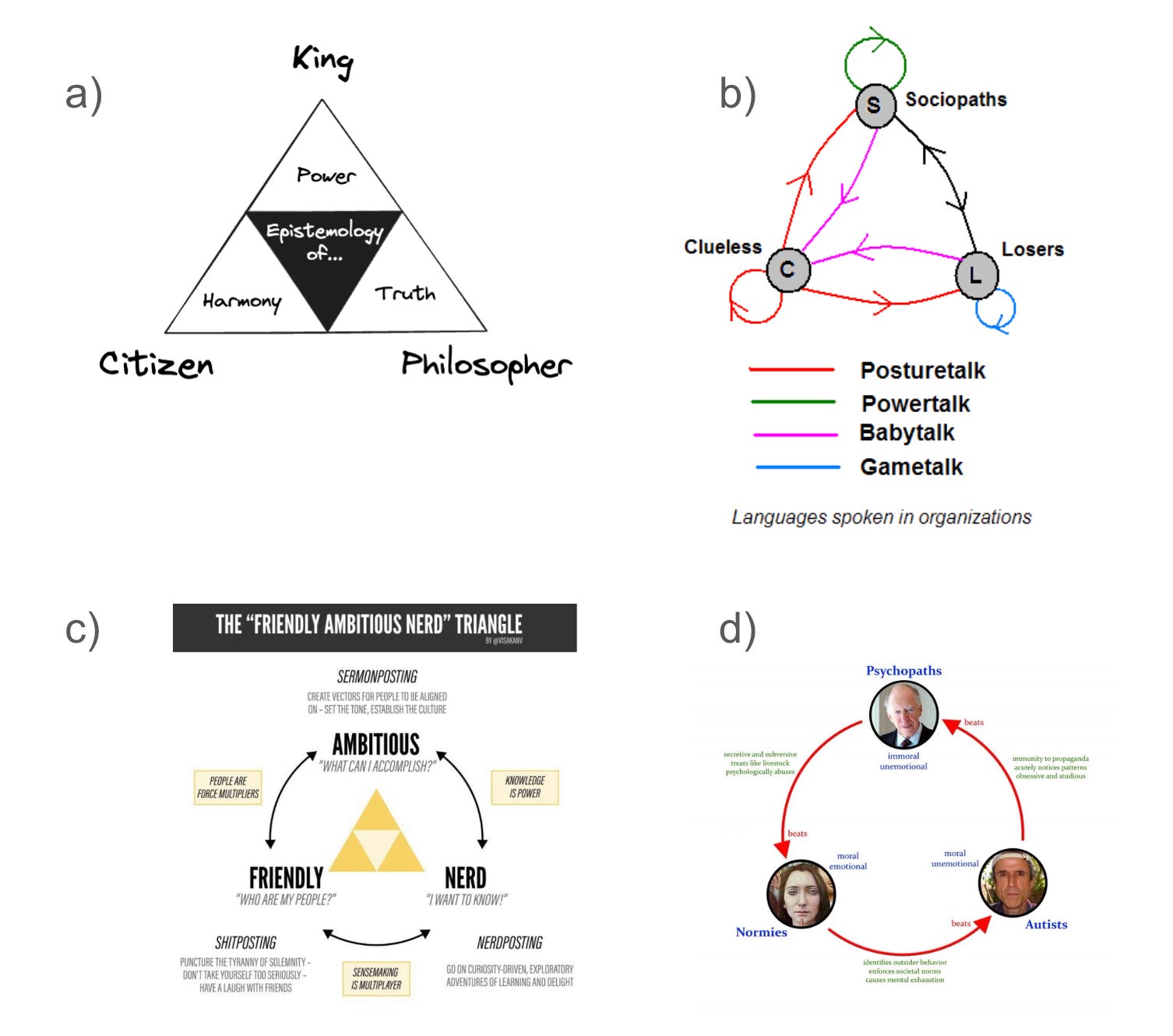
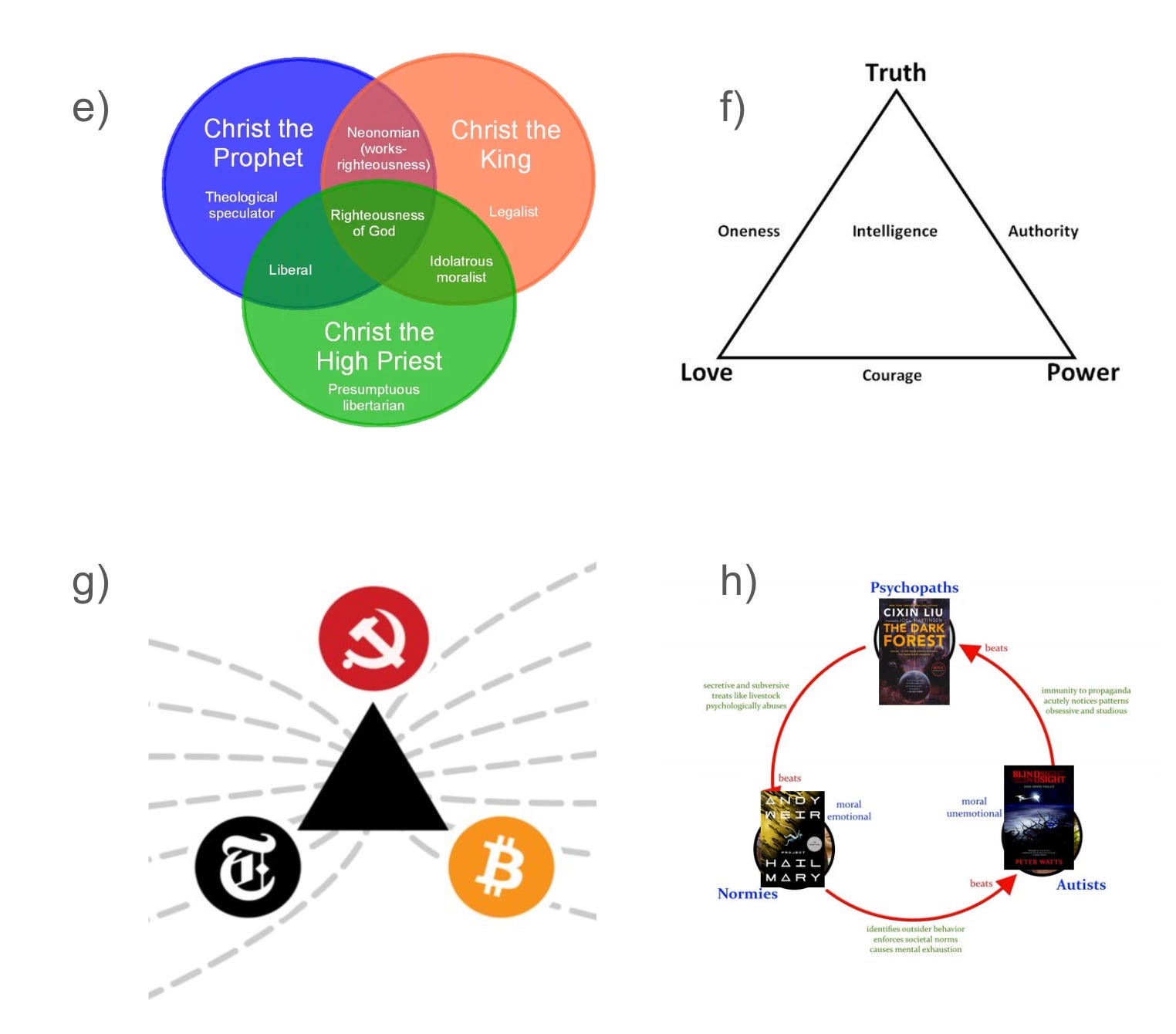
The recurrence of this structure across such different domains — sitcom, theology, self-help, internet meme, geopolitics — suggests it is observed rather than invented. Something about the human social world keeps producing this shape. Each map is also vulnerable to its own pathology when it is held to the exclusion of the other two. The pathological king, holding only the map of power, becomes the sociopath: ruthless, isolated, incapable of seeing anything that does not advance his outcome. The pathological philosopher, holding only the map of truth, becomes the dork: powerless, loveless, technically correct but useful for nothing. The pathological citizen, holding only the map of harmony, becomes the normie: a pawn who follows convention and upholds taboos in order to hold the group together.
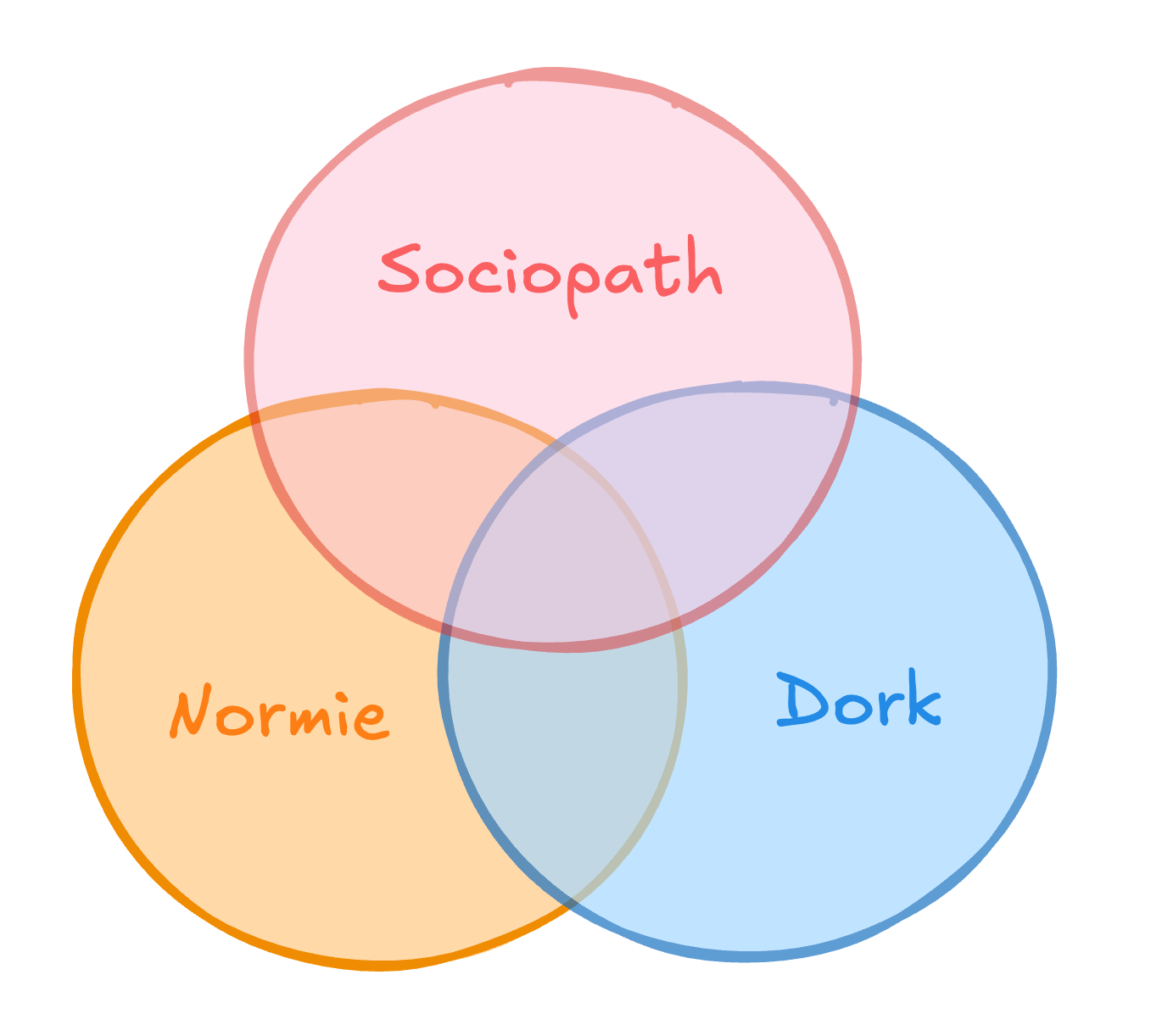
The triangle is older than any of the thinkers who noticed it. Human groups exhibit persistent behavioral diversity — some members are bold, others cautious; some prosocial, others self-interested; some drawn to consensus, others to confrontation — and there is good reason to think this diversity is itself adaptive. A group of only one type is fragile in a way a mixed group is not. The recurrences in Figure 2 suggest that the Citizen-Philosopher-King division may be one useful way of carving up this diversity, picking out three orientations that show up reliably enough, in domains far enough apart, to deserve a name.
These maps, then, are not chosen the way we choose an outfit. They are inherited dispositions older than choice, shaped by an evolutionary history in which behavioral variation was itself an asset. The strongman did not appear with the nation-state; he was already there in the alpha males of our pre-human ancestors, where dominance was a high-risk, high-reward reproductive strategy. What disrupted that strategy, as Christopher Boehm argues, was not the sudden moral improvement of the weak but their capacity to act together. The dominant male could be checked by ridicule, gossip, disobedience, ostracism, coalition, and, in extreme cases, execution (Boehm, 1993, 1999). Brian Klaas popularizes this argument in Corruptible, emphasizing the political importance of weapons that made the strongman killable from a distance stemming from the evolution of the human shoulder (Klaas, 2021, chap. 2). Spears and bows mattered, but the deeper shift was social: the group learned to raise the cost of domination above its reward. This meant that for most of our species’ history we lived, for the most part, kingless. The egalitarian structure of many forager societies still visible to anthropologists is not a democratic achievement in the modern sense. It is what happens when ordinary people collectively prevent the would-be tyrant from converting strength, charisma, or hunting success into permanent rule.
Around 10,000 years ago, agriculture changed the equation. There was now something to defend, and the groups that defended it best were the ones with strong centers. Big army beats small army. The king returned, and to hold the new structure together, he laid down the law. But the king himself was marked, across cultures, by his willingness to break it. Marshall Sahlins and David Graeber, surveying kingship across an enormous range of societies in On Kings, described the pattern this way:
On his way to the kingdom, the dynastic founder is notorious for exploits of incest, fratricide, patricide, or other crimes against kinship and common morality; he may also be famous for defeating dangerous natural or human foes. The hero manifests a nature above, beyond, and greater than the people he is destined to rule — hence his power to do so. (Graeber & Sahlins, 2017, loc. 298).
Transgression became a costly and therefore honest signal of how far the king was prepared to go to get power and to keep it. He was the bad man who could protect his people from the other tribe’s bad man, and the bad man you did not cross.3 In the Philippine context, and particularly among Mindanawon scholars, this figure has a name: the orang besar, “big man” in Malay — a term used for datus and sultans that echoes their age old and archetypical roles in maritime Southeast Asia.4 Most of us arrive at a film like Quezon already wearing one of the three lenses, and the lens we wear tends to have a blind spot precisely where this figure lives. Quezon is interesting — and for many of its viewers, unsettling — because it temporarily unveils this blind spot.5
What Quezon Knows
The film announces its philosophical thesis early on, in its poker scene. Quezon, his cards on the table, is being challenged by the young journalist Joven Hernando over the ethics of leadership. Quezon does not argue, but instead surrenders his hand:
”O eh ‘di full house! Fold na ako! Wag tayo magtalo sa philosophy ethics, kumpare. Hindi ko magagamit ang abstract virtues sa totoong buhay. Napakadakilang bagay ng katotohanan pero hindi ito palaging epektibo sa pamumuno.”
[So then, full house! I fold! Let us not argue philosophy ethics, my friend. I cannot use abstract virtues in real life. Truth is a magnificent thing, but it is not always effective in leadership.]
For Quezon, philosophy is one more hand in the game of power — truth is a card he folds the moment it stops winning. The epistemology of power does not deny that truth exists. It simply subordinates truth to outcome, the way a poker player subordinates the value of any individual card to the value of the pot. This is the film’s argument delivered through dialogue and metaphor: the epistemology of power is not the absence of philosophy but a particular philosophy, with its own internal logic and north star.
President Quezon is the film’s king. Joven Hernando is its philosopher — the character who embodies the epistemology of truth. He relays his lineage in his counter to Quezon: “Hindi ka ba nagbasa ng Aristotle? Mill? Rousseau? Kant? Katotohanan ang pundasyon ng isang maayos at makatarungang lipunan!” [Have you not read Aristotle? Mill? Rousseau? Kant? Truth is the foundation of an orderly and just society!] Joven is unable to speak the king’s language of power. He is not appealing to strategies and tactics useful for winning the particular game they are in; he is appealing to a tradition of thinkers who believed in universal and unchanging truths: maps that will always represent the territory of reality.
The film shows the pathologies of both king and philosopher. It depicts president Quezon’s sociopathic tendencies and Joven’s naiveté and powerlessness. The journalist’s uncle Miguel tells him, “Di kaya nasa hawlang ginto ka na? Paano mo mapapangalagaan ang katotohanan kung isang panig lang ang iyong nakikita? [Are you not already in a gilded cage? How can you protect the truth if you only see one side?] The pathology of the philosopher unmoored from the two other epistemologies is precisely this: his truth is powerless, unable to protect those he loves or change society. Truth without power or harmony produces a prophet that no one hears or understands — a dork in other words.
Who occupies the epistemology of harmony in the film? To me, the most generative occupant of this corner is not a character in the film. It is us, the audience.
What is Quezon telling us, the normie audience, with its film-within-a-film device? Nadia Hernando, daughter of Joven and Quezon’s godchild, is an aspiring filmmaker. She creates black-and-white reels for Quezon’s presidential campaign — silent films in the style of early Philippine cinema that blur the lines between propaganda and art, truth and myth. We then see how Nadia made two versions, one glorifying Quezon, another condemning him, showing us that history, like film, depends on which cut is produced, shown, and preserved. And in Tarog’s metareel, we are asked to notice that we are sitting in the same seat Nadia’s audience sits in.
This is the film’s argument about those of us who are neither kings nor philosophers, neither players willing to break taboo to gain power nor prophets willing to speak truths that could get them lynched by the mob. Most of us must be normies for societies to survive. Too many kings and the polity becomes a war of all against all; too many philosophers and the polity becomes a navel-gazing academic seminar. The citizen is the foundational substance of civilization: the one who tolerates contradiction to keep the peace, honors the sacred and the boundaries of taboo, laughs at the over-serious truth-teller, and joins the collective murmur against the man who reaches too greedily for power.6
What Quezon grasps, and what makes the film philosophical rather than merely satirical, is that the citizen’s murmur is itself one of the forces the king must learn to read. The audience is not a neutral jury weighing evidence about president Quezon. The audience is the medium through which his power moves — the water in which the dance of statecraft happens. Nadia’s two reels are not competing reports about a man; they are competing attempts to shape what the citizenry will feel, remember, and repeat. The film knows this, and it knows we know it, and it seats us in the position of the substance being worked.
This is where the philosophical argument of Quezon opens onto its deepest question, the one Avanceña’s protest could not see because his lens was trained on the dignity of an individual rather than the architecture of power. Most of us live inside the cultural currents of nation, faith, family, and moral consensus the way a fish lives inside water — so completely that we do not notice the medium at all. The man who becomes king is, among other things, a man who has learned to see the water.
The Man Who Sees the Water
Strength explains very little about who ends up ruling the room. If power were only strength, the biggest man would always hold it. Knowing and speaking truth also have little to do with gaining and holding power. Quezon knows better. Power belongs to the man who sees the medium everyone else mistakes for reality.
Let’s look again at what the film tells us through Nadia’s campaign reels. She is not only making advertisements. She is manufacturing versions reality. In one cut, Quezon is the vessel of Filipino destiny: the polished statesman, the champion of independence, the necessary man. In another, he is exposed as a manipulator — the man who bends truth, rivals, women, journalists, and public memory toward his own ascent. The facts do not change. The lens, the water, through which we see them changes. The same man, the same events, the same nation, and yet a different spirit moves through the room.
The ordinary citizen receives the reel as reality. The philosopher interrogates it as truth or falsehood. The king sees something else entirely: the reel does not merely describe public feeling but creates it. He watches it teach the crowd what to admire, what to resent, what to fear, what to forgive, what to forget. He watches it take the loose, formless energies already present in the people — resentment for a dead colonial empire, an emerging imagined community, hunger for independence, weariness with old revolutionaries, desire for a father of a nation — and gives them a face. It was president Quezon’s face during the era depicted by the film. Men and women of power have competed for that position ever since.7
The film shows us what the epistemology of power understands which the other corners miss. A nation moves primarily through charged images, remembered injuries, sacred names, humiliations waiting for a voice, enemies waiting for a shape — far more than through philosophical propositions. The film’s final declaration — “I am the Philippines” — is therefore the logical endpoint of Quezon’s game, not merely megalomania. He has spent the film learning to fuse his private ambition with the symbolic body of the nation-state. His enemies become the enemies of the country. His survival becomes the survival of the project of nation-building. His image becomes inseparable from independence itself. What began as campaign becomes incarnation.
This is the oldest magic of kingship in modern dress. The king’s body becomes the body politic. His hunger becomes policy. His grudges become history. His victories become national destiny. He does not merely rule the people; he offers them a way to imagine themselves. And because the offer meets a real need, the people participate in their own enchantment.
The uncomfortable reality is that the king cannot become king alone. He needs philosophers to either be his mouthpieces or remain powerless dorks that cannot speak to the crowd. He needs citizens to be normies too tired, anxious, loyal, conflict-averse, and hungry to question his comforting story. He needs enemies who can be made to bear the sins of the whole. He needs artists, journalists, bureaucrats, soldiers, friends, mistresses, rivals, and relatives to become pieces on the board.
The film speaks from the epistemology of truth, exposing the reality of the man of power. It refuses to place his machinery outside the theater. We watch Quezon being mythologized and demythologized, accused and defended, enlarged and diminished. We judge him, then notice that our judgement too has been arranged by cuts, scenes, dialogue, performance, omission. We are not outside Nadia’s reels.
This is why Quezon is doing philosophy. A lecture would only tell us about abstractions of the man of power. The film instead makes us experience the condition power requires: the king’s transformation of invisible forces — resentment, prestige, shame, national longing, revolutionary memory, colonial humiliation, family loyalty, fear of the Other, moral disgust — into stepping stones to the throne.
Power lives in the crowd before the speech begins. It lives in the story a people is prepared to believe. It lives in the man that can make the contradiction and complexities of the real world disappear. It lives in the victim whose sacrifice can make everyone feel clean again. It lives in the sacred word — Independence, Nation, People, Order — that turns private ambition into public necessity.
Kings are not merely men who impose their will upon society. They are men and women who see the will already forming inside society and speak to it in a voice it understands.
Conclusion
I have argued in this chapter that Quezon is doing philosophy — that the film makes an argument about power through the three epistemologies, using the man on the screen as the case through which the argument runs. I want to close by pressing that claim one step higher.
Even among storytellers, there is a choice of epistemologies. And that choice is made within the constraints of our medium. The forces gathered around our canvases — money, audience, distribution, censors, the actors’ careers, the descendants that might sue — are not neutral. They are the citizenry pressing in on the work, asking it to confirm what citizens already believe about their king. The storyteller’s first decision is whether to yield that pressure or to fight against it.
This is where Avanceña’s protest deserves a more careful answer than the one I gave in the introduction. He was not wrong about what he saw. The film did sacrifice his grandfather’s biography. It compressed, invented, exaggerated, and rearranged. These were choices made under the discipline of a medium that must hold an audience for two to three hours and send it home with something to argue about over coffee and social media. Tarog, in making them, was operating not purely from the philosopher’s epistemology, but also the king’s epistemology of power.
The film itself, in other words, is an act of power. It bends the historical record toward the outcome it needs — drama, controversy, box office, and (this is what makes it more than mere spectacle) the truth of the man of power conveyed to a citizenry that famously does not read. To reach the audience that needs to see it, the film must speak the audience’s language. To speak that language in two hours and twenty minutes, it must compress a life into a case. And to compress that life into a case is to do, on a small scale, exactly what Quezon did: subordinate one truth to an outcome. The film sacrifices dorky accuracy for the sake of a powerful story.
Tarog says that most scenes in the film can be found in historical sources.8 I’ve repeatedly claimed something similar for Rajah Versus Conquistador: that I was maniacally faithful to the historical and anthropological record (but I also add that I was deliberately unhinged within the records’ gaps). I volunteered to write this essay because I sensed that Tarog and I both wanted to reveal the same truth: the chameleon-like man of power. Not only that; I sense that we listen to the same diwata, the same muse. There are countless of events in a man’s life, especially a life as dramatic as Quezon’s. Which ones do you exclude? Which ones do you depict? How do you depict them?
For instance, Tarog depicts Quezon stripping Aguinaldo of his pension, confiscating his farmstead, and sending his own sergeant-at-arms to sabotage the old revolutionary's rally in Malolos. To the ordinary viewer, this is damning. But to anyone familiar with the orang besar — the Southeast Asian strongman in his fuller historical range — Quezon's pecadilloes and maneuverings look almost gentlemanly. It is a terrible bar, but Quezon did not have rivals killed, and there were no massacres under his Commonwealth. The transgressions Tarog chose to depict are the kind a man of power commits when the institutional ring around him still mostly holds. And yet — this is the point — these comparatively mild transgressions were enough to provoke Avanceña's protest, enough to unsettle a citizenry that has lived through far worse and named far worse heroes. Tarog's depiction is extremely entertaining and, as I have argued throughout this essay, reveals to a massive audience what scholarship can only whisper to a few. The craft is in the calibration: just transgressive enough to puncture the ring, restrained enough that the audience does not look away. We can reverse-engineer the principle underpinning Tarog's creative choices through our experience of the film. My own experience tells me that Tarog is neither a propagandist nor a scholar. He is a storyteller.
This does not mean that the film does not speak truth. In fact, historical fiction is in some senses more true than plain history. Plain history catalogues what happened. Historical fiction lets us experience what it meant — what was at stake in the room, what was being protected, what was being sacrificed, what the participants themselves could not afford to see. The historian who tells us that Quezon stripped Aguinaldo of his pension has given us a fact. The film that shows us Quezon doing it — and shows us the citizenry whose hunger for a new father made the stripping not only possible but quietly desired — has given us the story beneath the fact.
What plain history cannot do, and what historical fiction sometimes can, requires the storyteller to break a taboo. The taboo varies by nation and by century, but its structure is constant: every polity surrounds its founding figures with a ring of pieties, and the ring is policed by the citizenry that needs those pieties to hold. The Americans have their Founders, who must be wise. The French have their revolutionaries, who must be just. We have our heroes of the 1890s’ and statesmen of the founding years, who must be examples to our youth, and our colonial encounters of 1521, which must be read as the prologue to a nation that did not yet exist.
The ring is the bond with which a citizenry holds itself together — the history taught to kids, the feel-good nationalist clips that go viral on social media, the monuments that everyone agrees not to question. But the ring is also opaque. You cannot see the man of power through it. You can only see the figure the nation needs him to be.
To render the man of power as he actually moved — calculating, transgressive, fluent in the resentments and longings of his people, willing to sacrifice the rival and the wife and the friend when the outcome required it — the storyteller has to step outside the ring. This is the move Tarog made with Quezon, and it is the move I made with Humabon and Lapulapu. This is what storytellers do when they are doing their work rather than the state’s. They walk through the ring. They accept that some part of the citizenry will read the walking-through as defilement.
What the storyteller gains by walking through the ring is the unmasking of man of power — that strange, charismatic, ruthless figure who keeps appearing in our history under different names, from Humabon to Quezon to our own power players of today. He becomes briefly visible. Briefly, because the ring closes again quickly, and the visibility has to be earned again by the next storyteller. But briefly is enough. The citizenry that has seen, even once, what the man of power actually looks like is a citizenry slightly less available to him the next time he arrives wearing a new face.
Historical fiction can speak truths that history cannot. — Kahlil Corazo
References
Abinales, P. N. (2020). Making Mindanao: Cotabato and Davao in the formation of the Philippine nation-state (Expanded ed.). Ateneo de Manila University Press.
Anderson, B. (2006). Imagined communities: Reflections on the origin and spread of nationalism (Rev. ed.). Verso. (Original work published 1983)
Anderson, B. R. O’G. (1998). Cacique democracy in the Philippines. In The spectre of comparisons: Nationalism, Southeast Asia, and the world (pp. 192–226). Verso.
Armitage, D. (2021). Philosophy’s violent sacred: Heidegger and Nietzsche through mimetic theory. Michigan State University Press.
Boehm, C. (1993). Egalitarian behavior and reverse dominance hierarchy. Current Anthropology, 34(3), 227–254. https://doi.org/10.1086/204166
Boehm, C. (1999). Hierarchy in the forest: The evolution of egalitarian behavior. Harvard University Press.
Campomanes, A. D. (2025). Lessons in historiophoty: A teaching and study guide for Quezon. DAKILA; Active Vista; TBA Studios.
Corazo, K. (2025). Rajah versus conquistador. PageCraft.
Corazo, K. (2025). The scapegoat mechanism in Southeast Asian ritual, myth, and politics: From Mead and Bateson’s Trance and Dance in Bali to massacres in the Philippines and Indonesia. Contagion: Journal of Violence, Mimesis, and Culture, 32, 67–89. https://doi.org/10.14321/contagion.32.0067
Girard, R. (1986). The scapegoat (Y. Freccero, Trans.). Johns Hopkins University Press.
Graeber, D., & Sahlins, M. (2017). On kings. HAU Books.
Hoffer, E. (1951). The true believer: Thoughts on the nature of mass movements. Harper & Brothers.
Junker, L. L. (1999). Raiding, trading, and feasting: The political economy of Philippine chiefdoms. University of Hawai‘i Press.
Klaas, B. (2021). Corruptible: Who gets power and how it changes us. Scribner.
McCoy, A. W. (Ed.). (1993). An anarchy of families: State and family in the Philippines. University of Wisconsin, Center for Southeast Asian Studies.
Pavlina, S. (2009). Personal development for smart people: The conscious pursuit of personal growth. Hay House.
Pizzolatto, N. (Writer), & Fukunaga, C. J. (Director). (2014, January 26). The locked room (Season 1, Episode 3) [TV series episode]. In N. Pizzolatto (Creator), True Detective. Anonymous Content; Passenger.
Rao, V. (2009–2013). The Gervais principle [Essay series]. Ribbonfarm. https://ribbonfarm.com/series/the-gervais-principle/
Roque, N. (2025, October 24). Apo ni Manuel L. Quezon, binatikos ang kinalabasan ng pelikulang “Quezon” na hango sa buhay ng kaniyang lolo. GMA News Online.
Sahlins, M. D. (1963). Poor man, rich man, big-man, chief: Political types in Melanesia and Polynesia. Comparative Studies in Society and History, 5(3), 285–303. https://doi.org/10.1017/S0010417500001729
Srinivasan, B. S. (2022). The network state: How to start a new country. 1729.
https://thenetworkstate.com/
Tarog, J. (Director). (2025). Quezon [Film]. TBA Studios.
Tarog, J. (2026). Quezon: From page to screen [Blog series]. Jerrold Tarog.
https://www.jerroldtarog.com/
Veerasamy, V. (2020). Friendly ambitious nerd [E-book]. Gumroad. https://visakanv.gumroad.com/l/FANbook
Wolters, O. W. (1999). History, culture, and region in Southeast Asian perspectives (Rev. ed.). SEAP Publications.
All transcriptions of dialogue from Quezon are drawn from Alvin D. Campomanes’ Lessons in Historiophoty: A Teaching and Study Guide for Quezon (2025), the official study guide released in connection with the film. Translations are mine.
Sources for Figure 2, panel by panel: (a) Citizen–Philosopher–King, from Corazo (n.d.), "Triangulations I: The founding murder," Explorations, https://www.explorations.ph/p/triangulations-i-the-founding-murder. (b) Sociopaths–Clueless–Losers, from Rao (2009), "The Gervais principle II: Posturetalk, powertalk, babytalk, and gametalk," Ribbonfarm, https://ribbonfarm.com/2009/11/11/the-gervais-principle-ii-posturetalk-powertalk-babytalk-and-gametalk/. (c) Friendly–Ambitious–Nerd, by Veerasamy, illustrated by Crandall (2020). (d) Psychopaths–Normies–Autists, internet meme, source unknown. (e) Christ the Prophet–Christ the King–Christ the High Priest, illustrating the munus triplex originating with Eusebius of Caesarea in the fourth century; diagram source: https://transforminggrace.wordpress.com/2009/06/02/christ-the-prophet-high-priest-and-king/. (f) Truth–Love–Power, from Pavlina (2009), Personal Development for Smart People, Hay House; brought to my attention by Meshach Thomas. (g) NYT–CCP–BTC, from Srinivasan (2022), The Network State, https://thenetworkstate.com/nyt-ccp-btc; brought to my attention by Ariel Bamar. (h) Adaptation by the author of panel (d), with first-contact science fiction novels at the three corners (The Dark Forest by Liu Cixin, Project Hail Mary by Andy Weir, Blindsight by Peter Watts).
The line I have in mind is Rust Cohle’s in the third episode of True Detective’s first season (“The Locked Room,” 2014), spoken to Marty Hart in the car: “The world needs bad men. We keep the other bad men from the door.” Like Quezon, the show is a work of fiction that philosophizes on the nature of power.
The concept I am invoking has more than one name in scholarly literature. The foundational text is Sahlins (1963), which introduced “big man” as a category in political anthropology and seeded the comparative literature that followed. Wolters (1999) refined the picture for Southeast Asia with his concept of “man of prowess” — the leader whose authority rests on personal numinous force rather than inherited office. Anderson (1998) reaches for the Latin American category of cacique to describe Philippine politics. The Malay term orang besar, “big man,” is a term I often hear from Mindanawan colleagues. I use it here because it captures a local strongman tradition that is continuous with the wider maritime Austronesian world. For Mindanao specifically, see Abinales (2020). For the broader Philippine pattern of family power, see McCoy (1993). For political economy of precolonial Philippine chiefdoms — raiding, trading, feasting, prestige, and ritual sacrifice — see Junker (1999). These are anthropological vocabularies, descriptions of a type from outside. For the inside view — the epistemology as it feels to the man who lives in it — I found Nietzsche’s master morality the most useful philosophical lens in writing Humabon from within. I read Nietzsche through René Girard critique — see Armitage (2021).
In the same year Quezon and Rajah Versus Conquistador were released, former president Rodrigo Duterte was detained at The Hague to stand trial for crimes against humanity. I have argued elsewhere that Duterte’s popularity throughout his presidency (2016–2022) was not despite but because of the killings in the drug war, and that the social dynamic at work is ancient — what Girard called “the ultimate craft of statesmanship,” the political weaponization of collective violence against a designated scapegoat. See Kahlil Corazo, “The Scapegoat Mechanism in Southeast Asian Ritual, Myth, and Politics: From Mead and Bateson’s Trance and Dance in Bali to Massacres in the Philippines and Indonesia,” Contagion: Journal of Violence, Mimesis, and Culture 32 (2025): 67–89, especially the section “The Ultimate Craft of Statesmanship.”
This claim is not meant as a demographic assertion that most persons can be statistically assigned to a fixed “harmony” type, but as an evolutionary and political-anthropological claim about the social function of the majority. Christopher Boehm’s account of “reverse dominance hierarchy” argues that egalitarian forager societies were not simply hierarchy-free, but were actively maintained by coalitions of subordinates who restrained would-be dominants through ridicule, gossip, ostracism, and, in extreme cases, execution. In this sense, ordinary norm-enforcement is not merely passive conformity but one of the mechanisms by which the group prevents the overmighty individual from converting charisma, aggression, or hunting success into permanent domination. See Christopher Boehm, Hierarchy in the Forest: The Evolution of Egalitarian Behavior (Cambridge, MA: Harvard University Press, 1999/2001), esp. 65–101; see also Brian Klaas, Corruptible: Who Gets Power and How It Changes Us (New York: Scribner, 2021), chap. 2, which draws on Boehm’s “reverse dominance hierarchy” in its account of how human groups flattened dominance hierarchies before the return of more durable hierarchy after agriculture.
From Anderson (1983/2006) comes the idea that a people is partly made by shared images and stories: the nation as an “imagined community.” From Hoffer (1951) comes the insight that mass movements gather strength by giving frustrated people an object for their longing and resentment. From Girard (1986, 2001) comes the claim that crowds do not merely hold opinions; they catch desires, fears, and accusations from one another until these converge on a shared object. The film reel, in this sense, is not just a record of public feeling. It is one of the instruments by which public feeling learns its shape.
Tarog mentioned this to me in a private message (J. Tarog, personal communication, May 9, 2026). He has since documented it in detail in a five-part blog series, walking scene by scene through the historical sources behind the film and listing more than fifty research titles consulted during the writing phase (see “QUEZON: From page to screen” in his blog, jerrodtarog.com)