

The manananggal splits herself at the waist each night, her upper torso sprouting bat wings to hunt pregnant women in their sleep. The penanggalan’s severed head trails intestines through darkness, searching for blood. Rangda spreads plague across Balinese villages with her supernatural powers. Across Southeast Asia, the pattern repeats: dismembered female bodies, supernatural evil, dead children. Why would there even be monsters? And why do female monsters—the evil ugly woman, the dismembered flying monster—appear with disturbing consistency across the region?
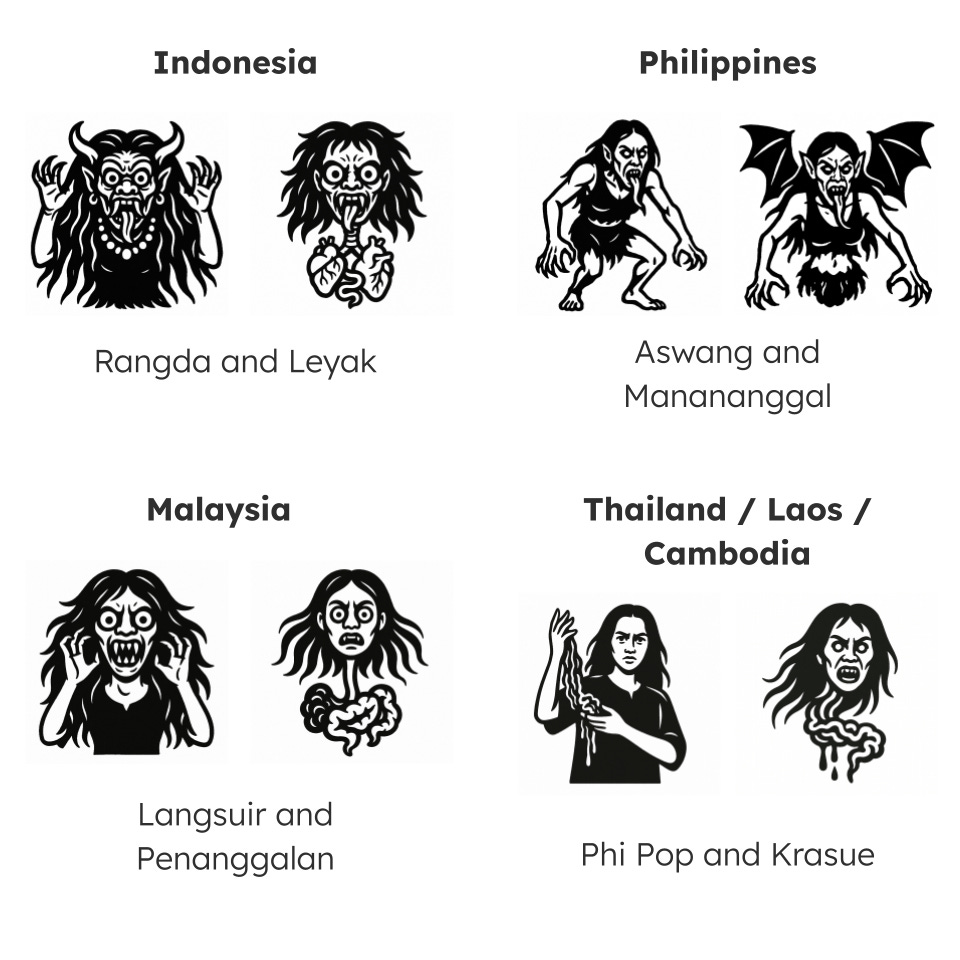
When I asked the Large Language Model (LLM) Claude AI these questions, it answered:
Threat detection and survival: Our ancestors survived by being paranoid. A hyperactive threat-detection system that sees dangers that aren’t there is safer than missing real ones. Monsters express evolved anxieties about predators, disease, darkness, and being attacked while vulnerable.
Explaining the unexplained: Strange noises, missing livestock, sudden deaths, and mysterious illnesses needed explanations. The manananggal, for instance, could explain nighttime disturbances or pregnancy complications.
Social enforcement: Monster stories often target transgressors. The aswang sometimes targets pregnant women or takes the form of norm-violators, reinforcing behavioral codes and warning children to stay close to home.
Universal patterns with local flavor: Specific details vary, but you see recurring archetypes—the predatory woman, the shapeshifter, the undead, the child-snatcher. This reflects common human fears (nighttime vulnerability, anxieties about women’s power, fear of death) expressed through local cultures.
LLMs are great for getting an idea of conventional perspectives. For instance, the illustrations above were made by ChatGPT. Being an LLM, ChatGPT based its drawings on patterns related to keywords used in the prompt. Rangda tends to be depicted as a monstrous female mask in traditional Balinese dances and the manananggal tends to have wings in Philippine films and comics. What’s interesting is that across these individual generations, we can see patterns: monstrosity (e.g., cannibalism) and dismemberment.
Claude’s output above also gives us an idea of conventional explanations of the phenomenon of monsters in myths. Conventional does not mean true or complete. In the case of the Southeast Asian female monsters depicted above, I argue here that René Girard’s explanation—the scapegoat mechanism—is better than the conventional ones. In this article, I relay Girard’s theory and apply it to our selection of monsters. Then I’ll use David Deutsch’s criteria for “good explanations” to show why Girard’s theory is better than the conventional explanations. I’ll then close with a discussion of how understanding the scapegoat mechanism enables us to reimagine these monsters—not as supernatural threats, but as victims whose stories demand to be told from their perspective rather than their persecutors.
Myths as Justification for Collective Murders
René Girard (1923-2015) was a French-American academic famous for two theories: mimetic desire and the scapegoat mechanism. He connects the two, but for our purposes here, we will just focus on the latter.
To Girard, myths are records of real events in the past that have been distorted throughout time both from incomplete transmission and deliberate obfuscation. These myths have commonalities because human societies across the world faced the same threats to survival as they evolved greater cognitive powers. These myths also record their common solution: the collective murder of an individual or a minority—the scapegoat.
Girard imagines the evolution of the proto-human and human mind across millennia and sees inevitable violence. Echoing Aristotle, he observed that humans are the most mimetic of creatures. We copy our desires from the people around us. Since objects of desire are limited (e.g., sexual mates), this inevitably leads to rivalry and violence. I’d add that we also developed much greater episodic memory than other animals and the ability to tell stories. Vengeance transcends generations. Murder is repaid with murder, and before long the incipient society is in an all-out war with itself.
The human societies that survived must have found a solution for the chaos that stemmed from mimetic rivalry and from inexplicable calamities like plagues. To Girard, this solution was the scapegoat mechanism. The chaos is blamed on a person or a minority, usually an individual or a group who stands out—the king, the stranger, the witch. Everyone is united in blaming the scapegoat and in their murder, so nobody is left to exact vengeance. Peace is restored. Stories are told to explain what just happened. To justify the collective murder, the scapegoats are turned into monsters with supernatural powers. Rangda is a witch that poisoned an entire village because the king refused to marry her daughter. The aswang and phi pop eat human flesh. The manananggal and penanggalan killed babies in the womb.
The Scapegoat Mechanism Also Explains Ritual Sacrifice and Massacres
What makes Girard’s explanation better than the conventional ones? To answer this, we need evaluative criteria. David Deutsch provides a useful framework in The Beginning of Infinity, where he defines what makes explanations “good.” To keep this article focused on monsters rather than epistemology, I’ll apply just one of his criteria: reach.
According to Deutsch, good explanations typically have reach: they solve problems beyond those that they were created to solve. For instance, the theory of evolution was developed to explain the diversity of species and their adaptations to their environments. But its reach extends far beyond biology—it illuminates patterns in linguistics (how languages evolve), computer science (genetic algorithms), economics (market dynamics), and even culture itself (memetics). A theory with reach doesn’t just answer the specific question it was designed for; it unlocks understanding across multiple domains.
On another dimension, good explanations are supported by multiple independent lines of evidence that all converge on the same conclusion. The theory of evolution demonstrates this: DNA sequencing reveals genetic relationships between species, the fossil record shows transitional forms across geological time, and vestigial structures—like the hind leg bones in whales, the human appendix, or the remnants of eyes in blind cave fish—all independently confirm the same story of descent with modification. When completely different types of evidence point to the same explanation, it’s a strong sign we’re onto something true about reality.
Girard’s scapegoat mechanism demonstrates both remarkable reach and convergent evidence. Three lines of evidence from Southeast Asia all point to the same underlying mechanism:
First, the ubiquity of ritual human sacrifice: Why do we find ritual human sacrifice in practically all societies prior to the axial age? In the Philippines, Narciso Tan’s comprehensive study Púgot: Head Taking, Ritual Cannibalism, and Human Sacrifice in the Philippines documents these practices across the country even until the 20th century. If we broaden this to include animal sacrifice, the practice becomes a cultural universal, like song and dance. The conventional explanations for monster myths—threat detection, explaining the unexplained, social enforcement—cannot explain this universality. Why would all human cultures independently arrive at the same gruesome practice? The scapegoat mechanism provides an answer: these rituals are controlled reenactments of original spontaneous collective murders that once saved communities from self-destruction. Because these foundational murders magically brought peace from chaos, they became imbued with the sacred—the victims transformed into gods or demons who demanded appeasement, and the sacrificial act became man’s access to supernatural power.
Second, the historical record: Jump forward to 17th century Manila and we find the massacre of sangleys (economic migrants from Southern China) in 1603, 1639, and 1662. These killings followed a pattern. During times of crisis and instability in the Spanish colonial order, tens of thousands of sangleys were collectively murdered by the colonial militias led by Spaniards and mostly composed of indigenous men. A similar pattern emerged in Indonesia centuries later: in 1965, an estimated 500,000 people branded as “Communists” were massacred during a period of political collapse and military-led consolidation of power following the attempted coup against Sukarno. In the 1998 riots during Indonesia’s political and economic crisis, Chinese Indonesians were the focal point of collective violence.
Third, the contemporary record: Fast forward to 2016 and Rodrigo Duterte’s “war on drugs” in the Philippines. Drug users and dealers became the new witches—blamed for the nation’s problems, stripped of their humanity through political rhetoric, and sacrificed in public displays of violence. Duterte explicitly promised collective murder as a solution to social chaos, and it worked politically precisely because the scapegoat mechanism resonates so deeply. Thousands were killed, their bodies left in the streets as modern-day “spectacles of the scaffold.” This wasn’t because Duterte read Girard or Foucault—it worked because he understood from his experience of ruling Davao what Girard called “the ultimate craft of statesmanship.”
Three completely different types of evidence—universal ritual practice, historical massacre, contemporary politics—separated by centuries and arising from completely different contexts, yet all revealing the same underlying mechanism. Like DNA, fossils, and vestigial structures pointing independently to evolution, these convergent lines of evidence suggest Girard identified something fundamental about human social behavior.
The Rangda-Barong Ritual: Southeast Asian Female Monsters in Living Form
In 1951, anthropologists Margaret Mead and Gregory Bateson released Trance and Dance in Bali, a black-and-white film documenting a traditional Balinese ritual they recorded in the 1930s. The timing matters—this was before mass tourism transformed Bali’s sacred ceremonies into cultural performances, and crucially, before the homogenizing forces of globalization could flatten these ancient patterns. For Filipinos, this film offers a recording of the same mythological patterns at “high definition” compared to our oral and written folklore, preserved in a form that escaped both Christianization and Westernization. If you’d like to watch the 20-minute film, you can easily find it through an internet search.
In the Balinese performance, Rangda is blamed for a plague devastating the village. The king’s emissary transforms into the dragon Barong to confront her. Knife-wielding dancers—young men from the village—repeatedly attempt to stab the witch but fail and collapse. The dragon revives them with holy water, putting them into a trance state. Women dancers then arrive and, at a scream from one of their number, go into trance seizures and turn their krises against themselves. The men likewise point their knives at themselves. The witch never dies (just as plagues return and new crises emerge). After the theatrical performance ends, the ritual culminates in animal sacrifice—the performer who played the witch, still in trance, bites off a chicken’s head—and the performers gradually recover from their trance.
What makes this ritual so revealing is its specificity. Mead and Bateson weren’t trying to prove Girard’s theory—they recorded this ritual when Girard was barely a child. Yet it depicts with uncanny precision every element Girard identified: a community in crisis, a scapegoat blamed for catastrophe, collective violence that unites the mob, and sacrifice as resolution. This is our own mythology—the aswang who causes mysterious deaths, the manananggal who steals fetuses, the communal violence against the accused witch—preserved in ritual form before modernity could obscure its meaning.
The conventional explanations Claude AI offered—threat detection, explaining the unexplained, social enforcement—can’t account for this convergence. They might explain why we fear monsters, but not why we systematically murder the people we label as monsters, ritualize these murders through sacrifice, and repeat the pattern across centuries whenever a skilled politician knows how to activate it. Only the scapegoat mechanism explains why ritual sacrifice is universal, why the same pattern appears in a Balinese temple ritual, why Spanish colonial massacres followed predictable triggers, and why a 21st-century populist’s rhetoric worked so effectively.
Reimagining the Monster
The scapegoat mechanism reveals why female monsters proliferate across Southeast Asian mythology with such disturbing consistency. The dismembered bodies—the penanggalan’s severed head trailing intestines, the manananggal’s bisected torso—preserve in mythological form the actual violence inflicted on real women. These weren’t supernatural beings who chose to split themselves apart; they were victims torn apart by mobs, their mutilated corpses transformed in collective memory from evidence of atrocity into proof of monstrosity. When communities faced crises they could not explain—plagues, famines, infant mortality—the defenseless and the strange—e.g., old women—became convenient targets. Once murdered, their deaths required justification.
We Southeast Asians hold supreme respect for our ancestors. We preserve their good names, honor their memories, maintain their shrines. This reverence becomes a prison when the ancestors we honor were themselves murderers, when the traditions we preserve encode ancient atrocities.
The West is not far ahead in this unveiling. Only in recent decades has Hollywood begun to realize that their witches were never guilty, that the trials and burnings were state propaganda. Films like Wicked and Maleficent represent tentative steps toward truth: what if the monsters were just women, and the real evil belonged to those who labeled them monstrous?
This is precisely the kind of radical reimagining that contemporary Philippine literature and visual arts must undertake. When we understand the manananggal as a dismembered scapegoat rather than a supernatural predator, when we recognize the aswang as a lynched woman rather than a baby-eating witch, we can begin to tell stories that speak the truth the victims instead of the violence. In the next chapter, I share my attempt at this kind of storytelling with an excerpt from my historical novel, Rajah Versus Conquistador. Whenever I describe this book to people familiar with René Girard, I say that it is science fiction, but the science is anthropology and the anthropology is Girardian.
We can honor our ancestors’ memory while refusing to perpetuate their lies. We can preserve tradition while refusing to let tradition preserve injustice. The urgency of this reimagining isn’t merely academic or artistic. The same mechanism that justified the murder of women accused of being aswang continues to operate whenever politicians weaponize the scapegoat mechanism. Until we excavate these myths and expose the violence encoded within them, the scapegoat mechanism will continue to operate, waiting for the next crisis to activate it. The monsters are waiting to tell their side of the story—and in telling it, they offer us the chance to break the cycle before the next mob forms, before the next scapegoat is chosen, before another street fills with bodies. We need only give them voice.
If the reader is interested in a more in-depth and scholarly treatment of the application of René Girard’s scapegoat mechanism to Philippine myths and political violence, see: Kahlil Corazo, “The Scapegoat Mechanism in Southeast Asian Ritual, Myth, and Politics: From Mead and Bateson’s Trance and Dance in Bali to Massacres in the Philippines and Indonesia,” Contagion: Journal of Violence, Mimesis, and Culture 32 (2025): 67–89,https://doi.org/10.14321/contagion.32.0067. It is behind an academic paywall, so please email the author at sugbu@corazo.org if you don’t have access but would like a PDF copy.
"what if the monsters were just women, and the real evil belonged to those who labeled them monstrous?"
Well, yes. A Seasian friend and I have posited that as the weaker, less powerful, more often brutalised sex, at all strata of society, it makes sense that traumatised women would come back as vengeful beings to haunt our collective psyches.