


I once had merienda with a visiting business professor. He had lived in the Philippines for a few years. We were poolside at The Polo Club, the clubhouse of the oldest gated community in Manila, Forbes Park. This American-era real estate project was so successful that you can now find gated communities all over the Philippines.
I went there by taxi, and I was in my Makati working man’s costume of gusot mayaman barong, not unlike the drivers waiting for their masters in the parking lot. I had to drop the professor’s name to get past security.
We talked shop for an hour or so, amid the din of families and groups of young people. At some point, the professor said, “You know, many of these wealthy families you see in the Philippines… they made their money through rent-seeking.”
Rent-seeking. It turns out this does not mean making money from renting apartments. Academics invented this term for a special kind of creature — one who gets rich without increasing wealth in society. People who need to create value to make money are like the plants and animals in a vibrant ecosystem. Rent-seekers are like parasites who grow by bleeding the life out of their hosts.
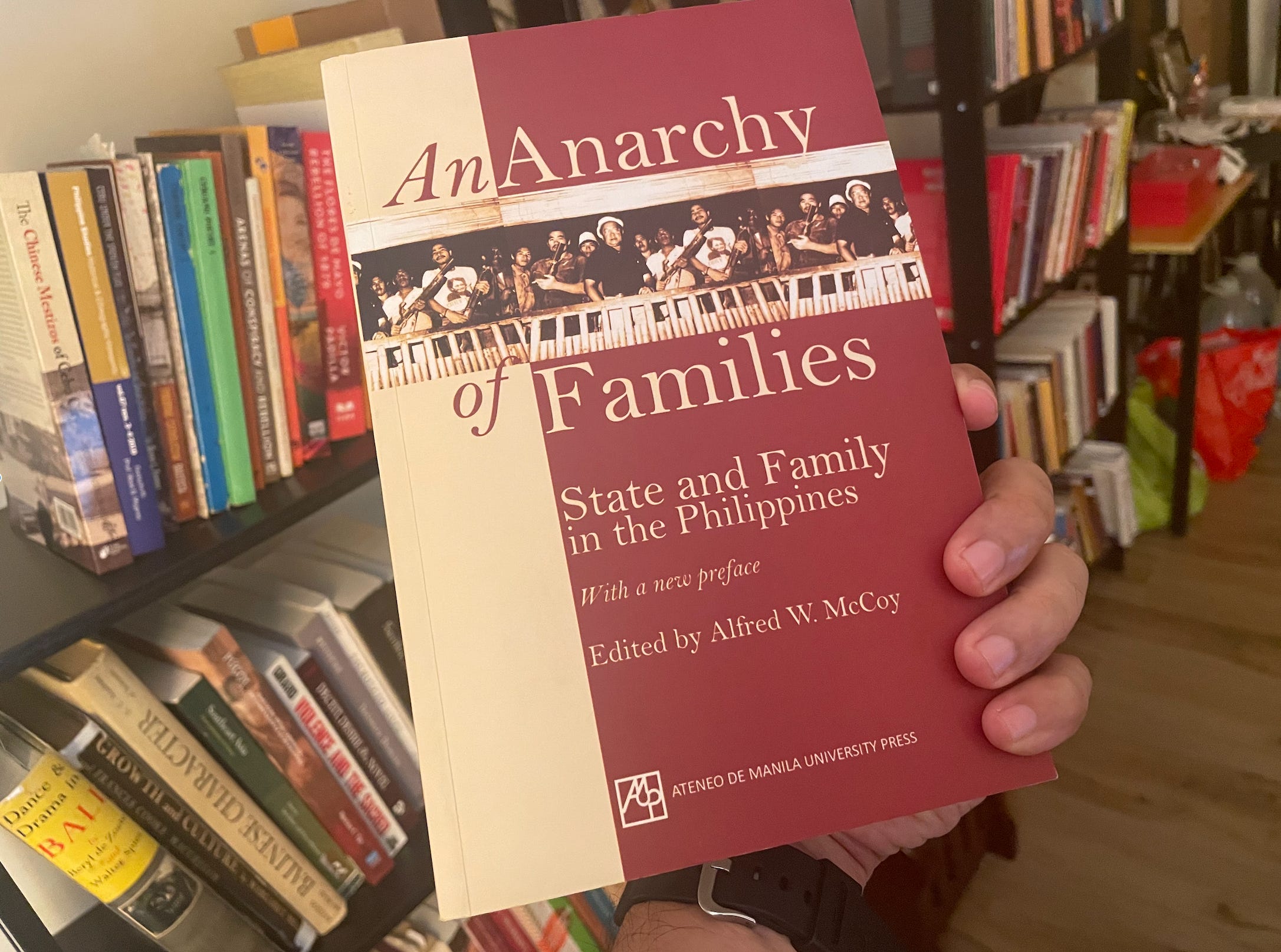
As far as I know, none of my friends and none of their families make money this way, including those in politics.1 Perhaps I’m simply not moving in the right (or wrong) circles. This must have been why I found the book An Anarchy of Families so fascinating.2 It was my first glimpse at how some of the most powerful families in the Philippines accumulate wealth through politics.
It turns out rent-seeking is not just one thing. There are varied ways of turning power into money, ranging from the debatably benign to the undoubtedly evil:
Officially Protected Businesses. When a government grants concessions or franchises, it controls the number of businesses that could compete in that market. This increases profits for the few businesses or the one business (monopoly) allowed to operate. Scholars call that increase in profit due to regulation “rent,” thus the name.
“We Can’t Help Benefiting from Our Great Job at Governance.” Let’s say you are the mayor. Your family has land all over the city. You make more or less justifiable decisions that just happen to increase the value of that land — for instance, where roads are paved. Who’s to say you’re not simply doing your job?
D.I.Y. Protected Monopolies. You push the envelope further. You love your people, so you give them each a cake on their birthdays. You also love your daughter, so you make her the exclusive supplier of those cakes. You love her a lot, so you pay her 3x the market value of the cakes.
Kickbacks. A bakeshop is nothing more than a passion project. The real money is in large government contracts. It is unfair, you feel, if these contractors make money and you don’t. You have invested so much to get to power, and it is now time for your family to enjoy its fruits.
Monetization of Evil. You cannot stop now. You need to stay in power to secure the position of your family. You already demand tribute from legitimate businesses. Why not get a cut from drug lords as well? Anyway, drugs happen whether or not you get a piece of the action. But you have your limits. You promise that you will never take a life to stay in power. That’s just too much. You forget that you said the same thing about drugs when you started your political career.
The book is dense and scholarly, with endnotes galore. But it hooks you on how familiar its subjects are. From the outside, they are no different from that nice political clan you personally know. Family is at the center of their lives. They are adept leaders and managers. Unfortunately, the game they play all too well is rotten at the core. They put in a lot of work, money, or violence to get to power — and once there, extract rent as if it were their God-given right.
Like celebrated entrepreneurs, these rent-seekers are awarded prestige by their communities. Society sees the same trappings of material success — large houses, luxury cars, membership in The Polo Club. For me, it took this collection of academic essays — and years of hardship in starting a business — to truly understand the difference.
It is easy to mistake the rent-seeking politician for an entrepreneur. On the surface, they look the same. They both play with capital. They effectively lead an organization. They take risks. If they succeed, their upsides could be huge.
They could not be more different where it truly matters. The entrepreneur needs to create value to produce revenue. The rent-seeker simply plays with the levers of power to transfer wealth from our pockets to theirs. The entrepreneur — in fact, anyone who works to get paid — increases the value circulating in the world. The rent-seeker just sucks it.
As the professor and I concluded our conversation, I looked again at the wealthy families surrounding the pool, with their children full of mirth, oblivious to the hidden games of this world. Did they truly create wealth, or did they power themselves into money? It is impossible to tell merely by appearance.
Yet this academic term, “rent-seeking,” has stripped appearances of its power, at least in my eyes. Without those trappings of wealth, who are you?
Understanding the “business” models of rent-seekers made me appreciate more those plain old entrepreneurs — the ones who built companies large and small without political sleights of hand.
And to the kids who will one day discover that their privileges were purchased with less than honorable means: I hope you will also realize that your family’s past need not define your future.
This is part of my essay collection, The Invisible Philippine War and Other Essays: Attempts at Making Sense of this Filipino Life.
I wrote this in 2017. I was wrong and naive lol.
Alfred W. McCoy, ed., An Anarchy of Families: State and Family in the Philippines (Quezon City: Ateneo de Manila University Press, 1994).
Following your analogy, I suppose the modern politician is more akin to private equities and investment bankers, than entrepreneurs. The latter is incentivized to provide value to make money (though whether that value is positive or negative, it depends. The founders of Helsing, Palantir, and OpenAI were technically entrepreneurs). While the former don't need to create any value at all; they don't even need to make the businesses in their portfolio prosper, as long as their exit price is high enough. Yet they hold some of the biggest chunks of wealth in the world.
Check out Elle Griffin's "shared-capitalism" model on Substack (forgot her actual term for it). Curious on your thoughts about that and whether it can be applied in real world Philippines, and what mechanisms could be used.
Governments everywhere exist primarily to enable rent-seeking.
The various tiers of government (Federal, State and local) in the United States of America are for the most part Platonic ideals of rent-seeking machinery.
The US Federal Government is the epitome of the whole disgraceful corrupt, immoral but legal (because the laws are carefully written by the rent-seekers who control government) enterprise.