

I thought my next book would be about my experience of writing Rajah Versus Conquistador. Those fifteen months felt like an adventure through an enchanted land where I spoke to gods and mythical creatures and where I discovered magical powers within me.
Then I remembered the words of Tim Ferriss, the author of The Four Hour Work Week: “what would this look like if this were easy.”
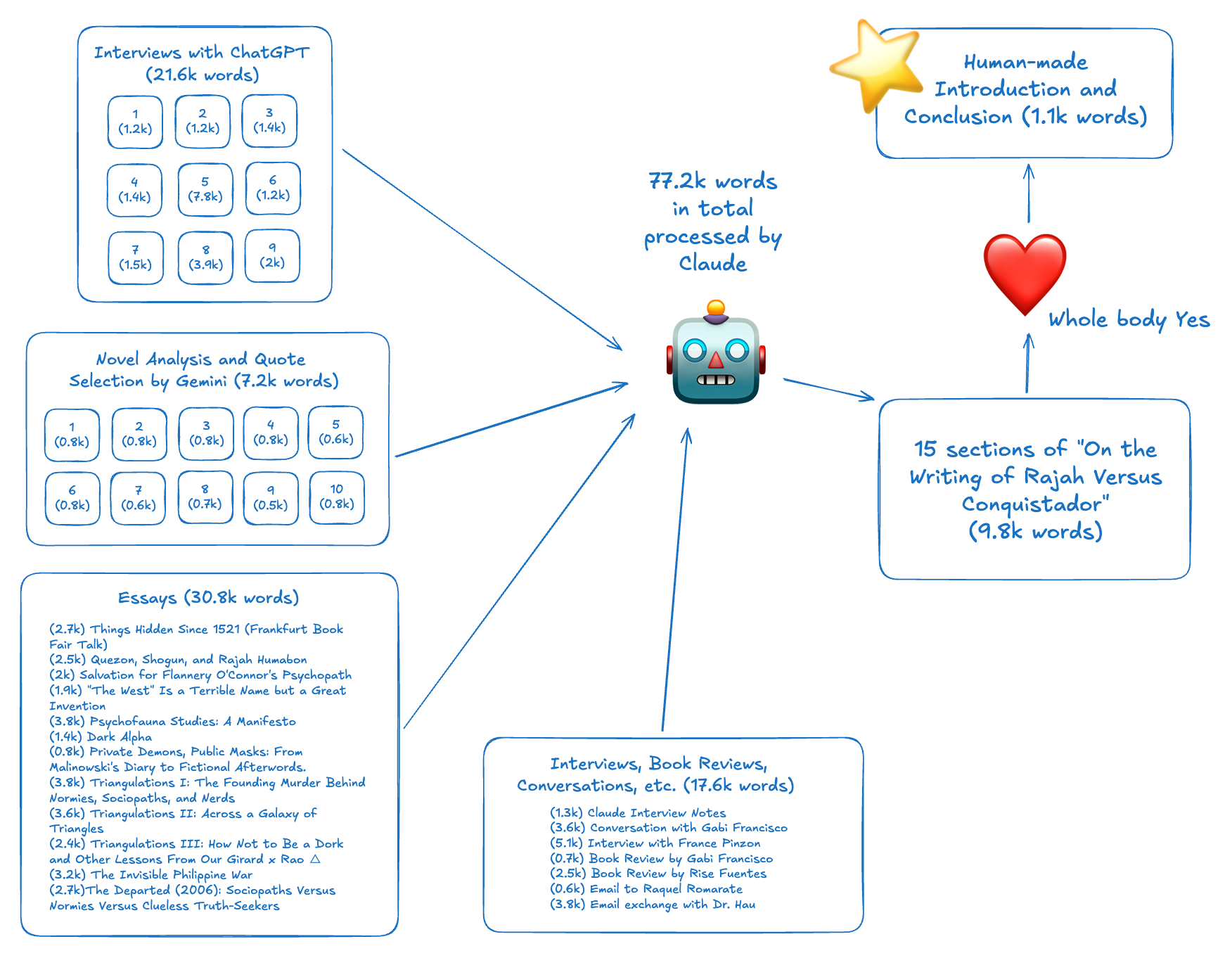
This led to an experiment of maxing out the use of three large language models: Claude, ChatGPT, and Gemini. The diagram above summarizes the process. I asked the latest model of Claude, Opus 4.5, to process 38 documents with a total word count of 77.2k words following variations of this prompt:
Can you create a comprehensive and detailed document that presents different aspects of my experience of writing RVC? Divide the document into these different aspects.
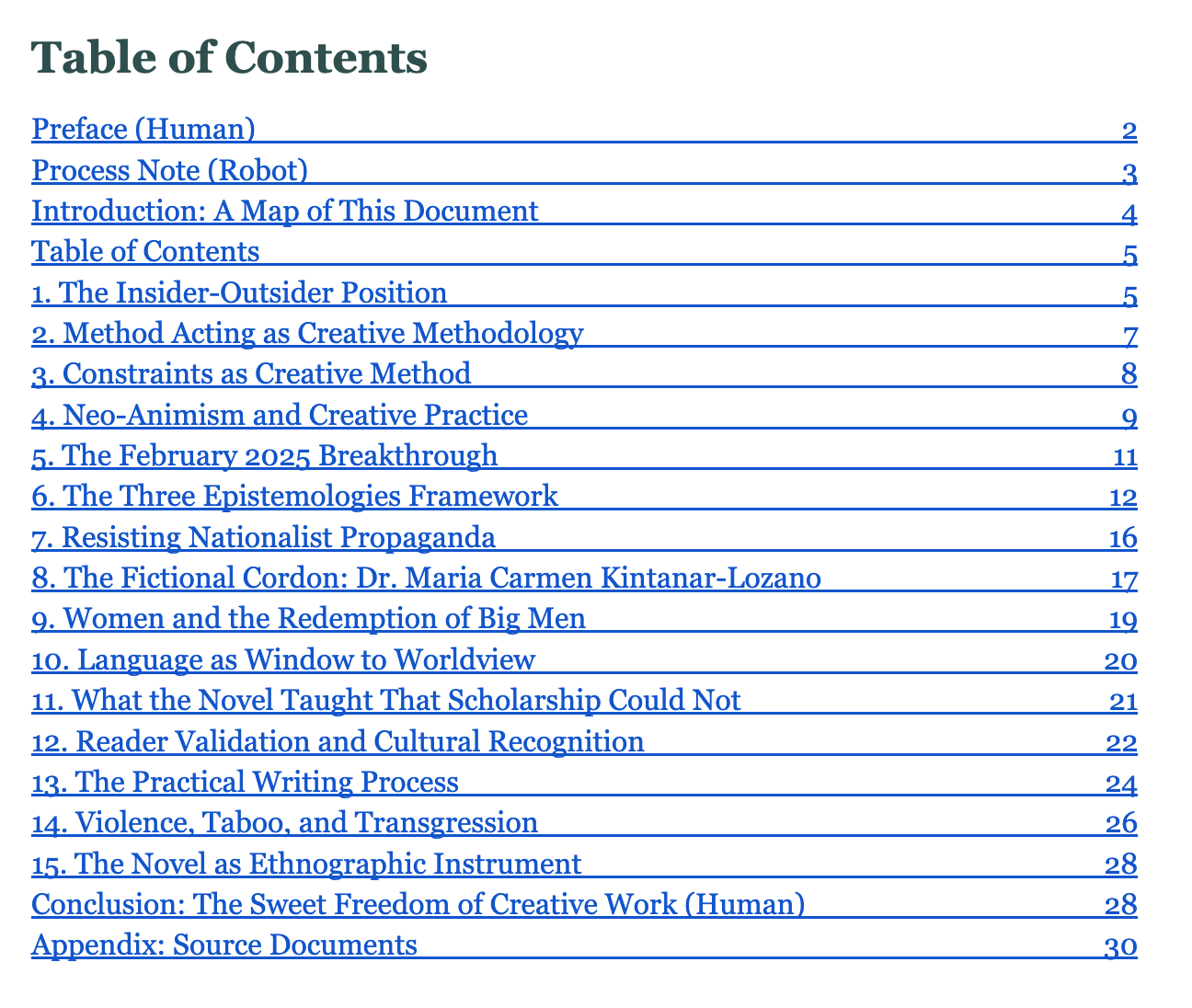
I cobbled together a ten-thousand-word document of from a few of its outputs. The document has fifteen sections, as seen in the screenshot of the table of contents below. In total, Claude probably spent less than 30 minutes on this project. In contrast, I have spent more than 8 hours on it as of this writing. Doing what Claude did myself would have taken me a few months. Nine of the docs came from transcripts of ChatGPT voice interviewing me about my experience. This was much easier and faster than writing it down. And I wouldn’t have done those interviews with a human: it’s simply wrong for me to inflict that level of suffering on a sentient being.
What none of the AI tools could do was to tell me the answer to this question: what made the experience of writing Rajah Versus Conquistador so strange and magical? The answer came instead from the “whole body Yes” that I wrote about in my first book, How to Turn Ideas Into Reality. The answer, however, relied on Claude’s distillation and ordering of my thoughts spread across the 38 source files. My answer is in the document’s conclusion, which I included in this post, along with the its preface (also handcrafted) and the table of contents. If you’d like to read the entire document, you can access it here.
Preface
The making of Rajah Versus Conquistador was extremely strange and magical. It felt like a hero’s journey: when I returned from that year-long adventure, I was a changed man. So I felt that I needed to capture that experience in writing. In addition, I have a scholarly and practical interest in creative work. My first book, in fact, is about project management for creative work and entrepreneurship.1
The biggest obstacle was how self-indulgent this entire project felt. The amount of navel-gazing that a book-length essay on my experience would require seemed poisonous to the soul. Fortunately, we now have robots to do the gazing for us. Except for this preface and the conclusion, this document was generated by Claude, based on my essays, interviews with ChatGPT, and other writings related to the experience of creating RVC. I’ve made manual corrections, and added footnotes, links, and images to this document.
Creating this document reinforced my antisacrificial tech optimism.2 The sacrifice needed to create this without AI would have been weeks or months of intellectual labor within an ouroboric maze. Conversing with ChatGPT voice made it easy for me to quickly release my thoughts on the experience of writing RVC before my memory of it faded. I fondly recall those conversations: I was on a patio in a cool pine-covered resort in Bukidnon as I answered a voice that never got bored with my rambling, sometimes incoherent, mostly awkwardly-worded first-attempts at expressing what were then nebulous and elusive ideas. If you look at the transcripts, you will see a massive pile of useless text, but within which are hidden words that capture my thoughts. Claude’s latest model, Opus 4.5, trawled through that wasteland as well as my essays within minutes and arranged the ideas it found into themes, the fifteen sections you see below. After a few attempts, it produced a number of versions I liked, which I combined to produce this document.
My tech optimism has not diminished my belief in humanity and its goodness. In fact, the experience of creating both this document and the novel made me more certain of the human core of creative work. AI, software, and tech are pure potential. It takes human desire to will into existence one single possibility within that vast universe of potentiality. Most combinations of letters are meaningless, and most combinations of words are slop. Yet within that universe of combinations lies Rajah Versus Conquistador and this document.
This document is much less polished than the novel, but it has fulfilled its role: this is the picture album that will remind me of that beautiful adventure. By reading through the sections below, I also found the answer to the question that spurred the creation of this document: what made that experience so strange and magical? I’ll leave the answer in the conclusion.
While I wrote this document mostly for myself, it might be useful as well to anyone interested in the creative process or who enjoyed the novel and is curious about how it was made.
— Kahlil
Table of Contents
Conclusion: The Sweet Freedom of Creative Work
That last section above was originally Claude’s conclusion. Perhaps the LLM overindexed this aspect because I was also using Claude to write an academic paper on “novel-writing as ethnography” while I was working on this document. That conclusion, however, simply did not feel right.
I fed Claude’s output to ChatGPT and asked it to suggest conclusions. It presented more than a dozen but none of them felt right. I also had a couple of theories. First was through a Girardian lens: perhaps art is a positive substitute to the catharsis of ritual sacrifice. The other was from neo-animism: perhaps living in the minds of my characters and of psychic megafauna is akin to the religious experience of transcending the self. However, these explanations also did not feel right.
There’s a fractal beauty in this criterion of “feeling right.” One reason for the strangeness and magical quality of the experience of writing Rajah Versus Conquistador was that I knew what was right. When reading a draft, I had complete certainty on whether or not it was right. Where did I get this knowledge? This was why chapters took so long to write prior to using Claude. This is also what made it so exhausting. It felt like squeezing my brain dry to produce and produce words and sentences and paragraphs—until it felt right. It is the same with this conclusion. Among the thousands of words in ChatGPT’s answer was “freedom.” And as I was getting ready for bed that night, the word struck a resonant chord, and suddenly my mind was reciting a litany of freedom:
Freedom from the limits of my self: listening to muses and living in the world of the novel as my protagonists
Freedom from the ethics of the nation-state: creating art instead of propaganda by escaping its possession through neo-animism
Freedom from the epistemology of academia: anthropological knowledge-creation through novel-writing
Freedom from my own worldview: creating minds not like my own through the Three Epistemologies and living through these minds by way of novelistic “method acting”
Freedom from the present: instead of using the past to deliver “moral lessons” for the present, as many Philippine historical novels do, I used the present to complete the gaps of the psychologies and cultures of the past
Freedom from my identity as an essayist and an explainer: turns out I can also be a storyteller!
Freedom from the logic of Technocapital: fifteen months of creative work instead of hustling for money
Freedom from consciousness: hours within the state of flow everyday
Freedom from the inner control freak: complete trust in the voices of inspiration
Freedom from the limits of my biological brain, my talents, and my skills: the usage of AI and other software
Freedom from traditions of Filipino literature and the taboos and status games of the communities surrounding it: writing as an ignorant outsider and only entering after the completion of the novel
Freedom from the constraints of the publishing industry: setting up a book production operation and doing my own launches and marketing
Freedom from the psychological need for anointing by publishers and taste-makers: direct appreciation from readers and book clubs
Freedom from my own scholarly critique: allowing the possibility of redemption for Humabon
Interestingly, I was not free from suffering. In fact, the making of the novel brought its own kinds of suffering: the pain of absence in seeing the book in my mind in contrast to its non-existence then. And prior to using Claude, the pain of knowing how the story’s voice should sound like in contrast to my ability to produce those words. This was why it took me an average of a month to complete a chapter without AI, and around a week with it.
This suffering might explain why I have no desire to go through that experience again. Well, I would. I won’t do it for the experience but I would for the outcome: a book that needs to exist but could only do so through my work. As I leaf through a paperback copy of Rajah Versus Conquistador, I am filled with wonder and gratitude. Just a few years ago, this book was just an idea—and now it is real. This beautiful thing was actually made through me! This is the sweet freedom of creative work.
— Kahlil
Excellent writing, bro :)