

I’ll be presenting at an anthropology conference later this year. The paper has been drafted and I’m currently working on my presentation.1 Public speaking is not really a problem for me. I enjoy it, in fact. I’m a little concerned, however, about what I will wear.
Those of you who have also been brought up in the venerable traditions of Filipino machismo know that this is against the rules. A real Bisaya man is not supposed to care too much about how he dresses. Or at least don’t be too public about it.
But, bro, it is already 2026. Plus, there’s a professional angle to this. Wearing western clothing — “neck and tie” lol or my usual tech casual — means something to people who study culture professionally. My Mindanawon colleagues sometimes wear blazers with lumad designs. In my case this feels borderline cultural appropriation, tbh, a recent immigrant to Davao (I have yet to move on from Woke 1.0). And like a shadow conscience, the voice of Filipino machismo within me whispers, “looks gay.”
I could of course wear a barong. I had no problem wearing one when I was working in Manila. But I ditched it when I came back to Cebu. It was a symbol of corporate slavery. And it’s barong Tagalog: cultural appropriation!
I changed my mind recently about the barong. This Drake meme is why.
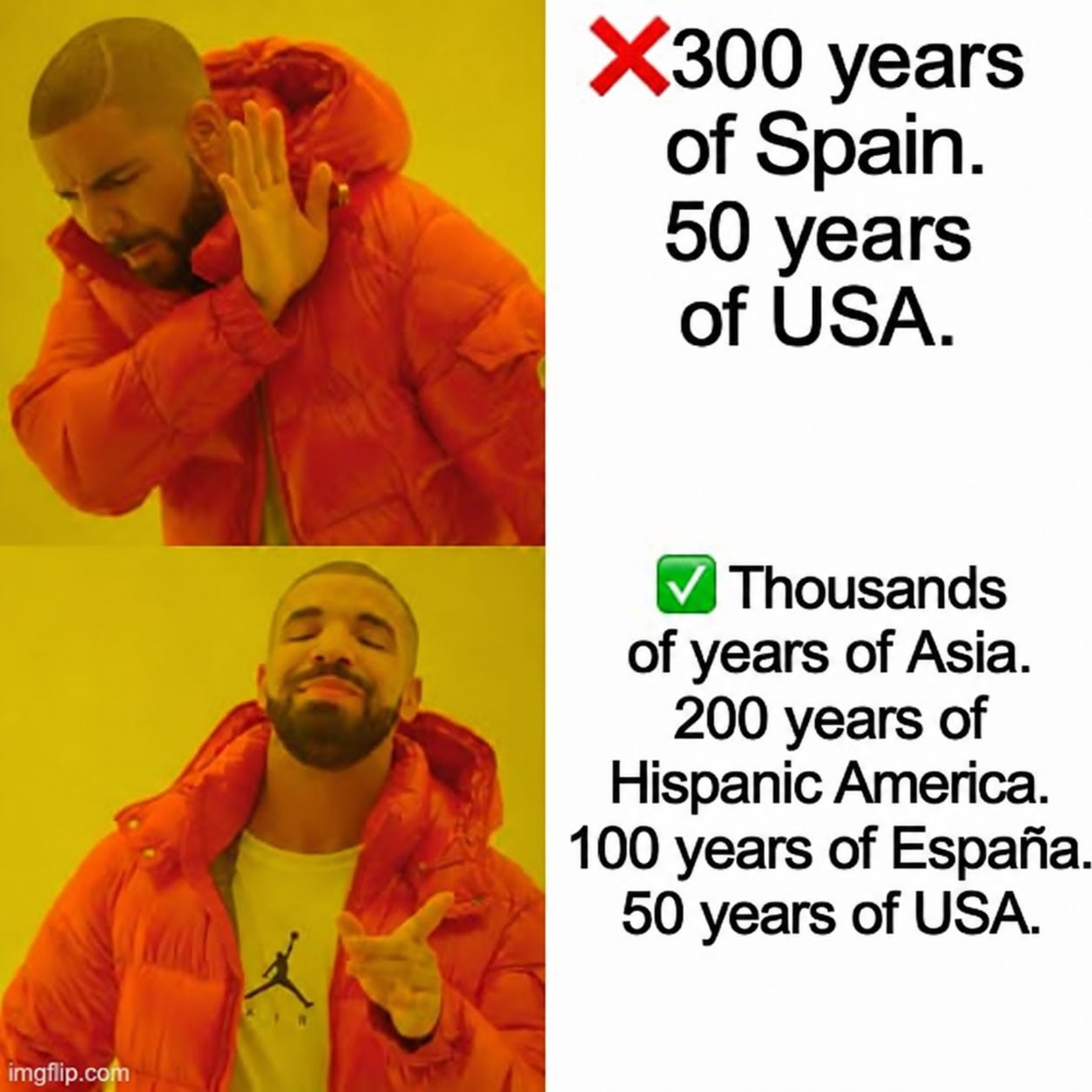
The most dressed-up man in Mactan
The biggest but most understudied roots of Filipino cultures, imo, are Asian, particularly Austronesian. Our fiestas, relationality (kapwa), gender relations, and politics all appear to stem from the chiefdoms of maritime Southeast Asia. We tend to attribute too much power to the Spaniards in shaping our culture, when they never reached beyond 4k at any given time and were limited to the most accessible areas in the lowlands.2
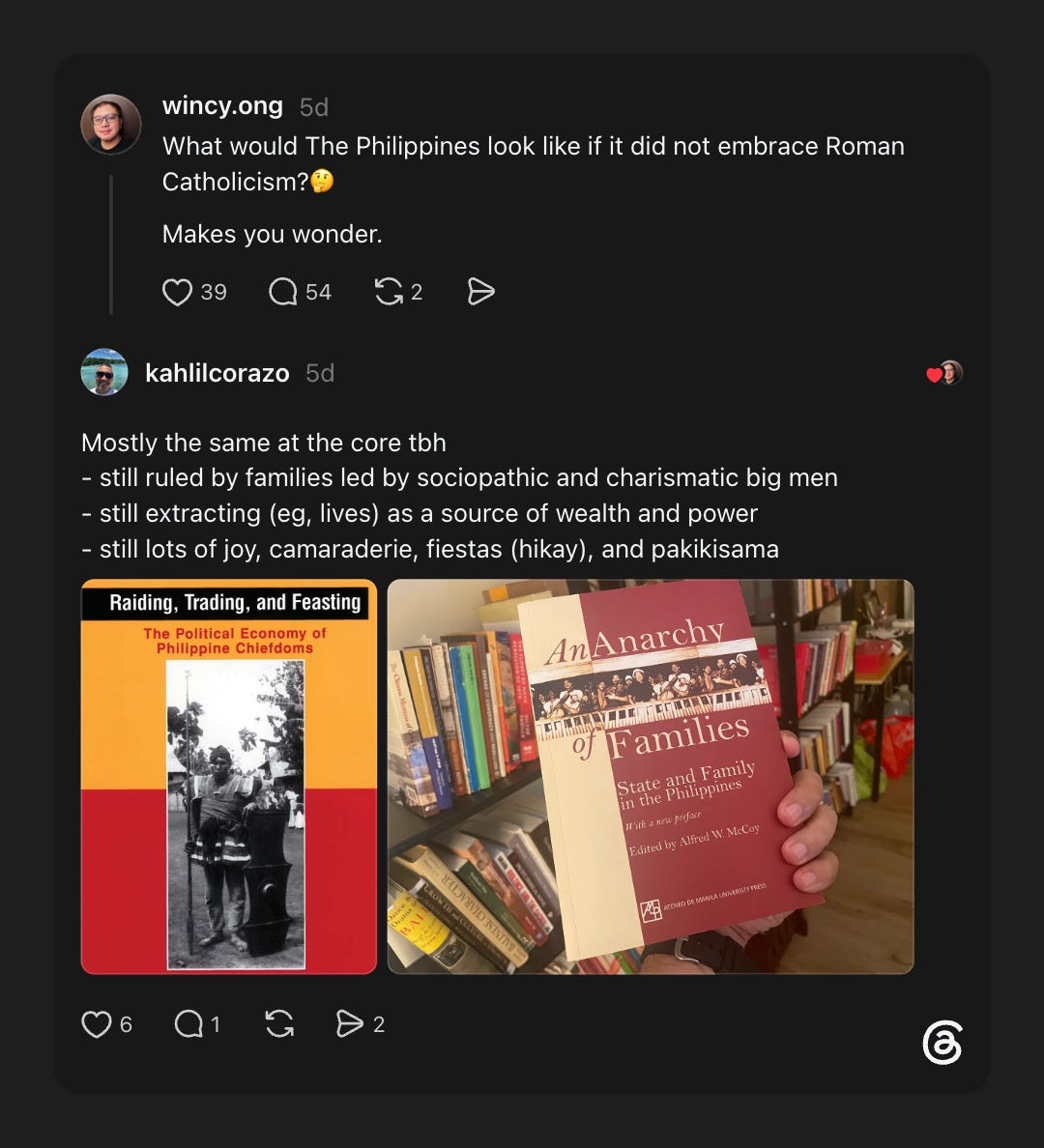
I did a deep dive into 16th-century prehispanic Visayan culture as I prepared to write Rajah Versus Conquistador, my retelling of the encounter between Rajah Humabon and Ferdinand Magellan in 1521. My goal was to recreate a Sugbo as culturally thick as the Europe presented in books about Magellan. It made me conclude that most of the characteristics of our cultures in the Philippines are shared with the Austronesian world. Eg, our elites have been desiring pale skin long before the pale man arrived.3
Which brings me to the most macho Bisaya man in our history.
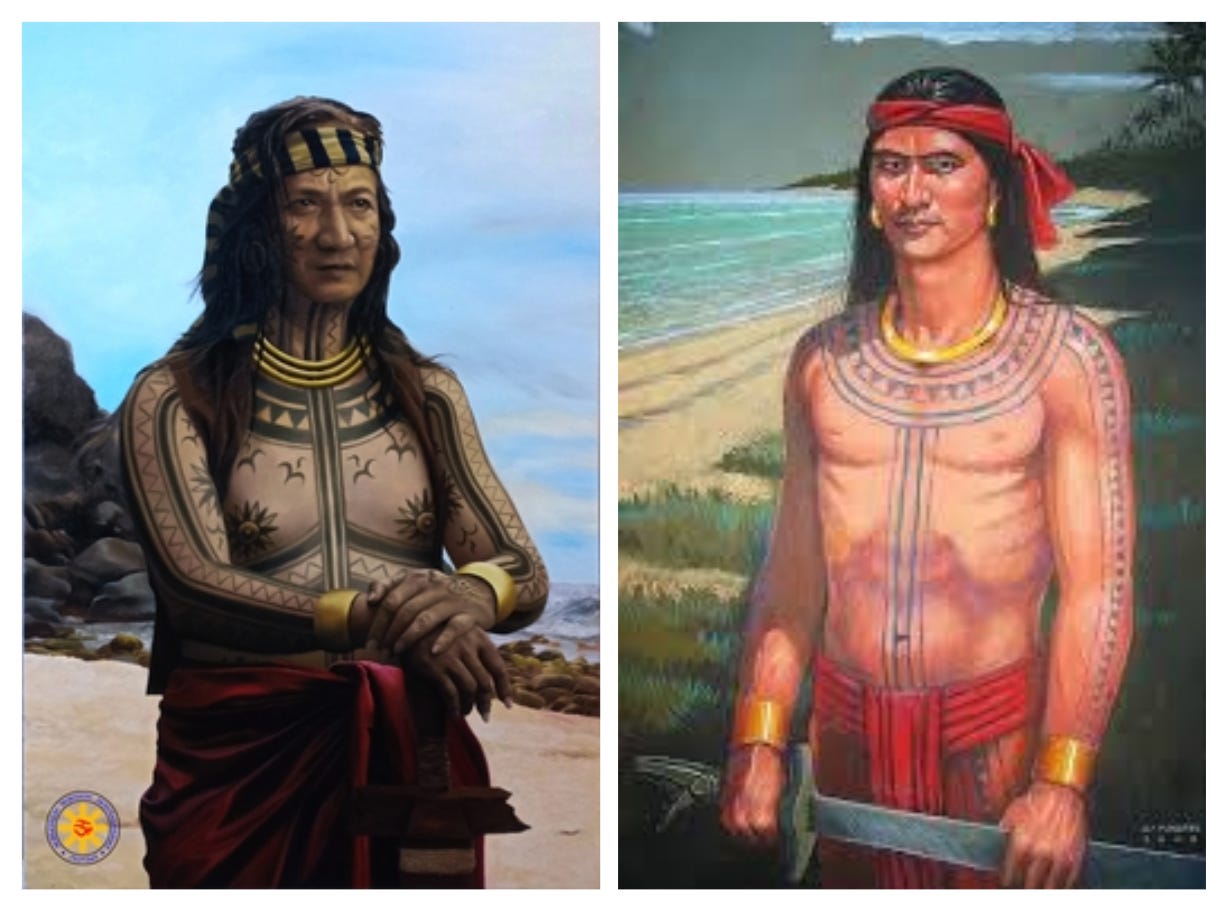
In RVC, I depicted Lapulapu as a venerated and feared warrior in his 70s (though he is in his 40s in a flashback chapter). This was influenced by Danny Gerona’s historical interpretation. No one among our primary sources saw him, but one says that he was velho, old.4 Gerona also surmises that a datu who can muster an army of 1,500 (Pigafetta’s count; other primary sources claim even more) must be a well-established and probably an old leader. I think this makes sense. He was an elderly datu who had decades to accumulate prestige, forge alliances, distribute favors, defeat rivals, and inspire both reverence and fear.5
I also depicted Lapulapu covered in patik, traditional tattoos. In the 16th-century Visayas, a man got inked only after a brave deed, and each new part of the body required another.6
Patik worked like a LinkedIn profile: work history (eg the enemies you defeated), endorsements, and accomplishments, all displayed on the skin for anyone to read at a glance.
A revered datu in his 70s commanding 1,500 warriors would have run out of skin to record his great deeds. According to William Henry Scott, the most badass warriors were tattooed right up to their eyelids!
These sparse geometric tattoos on Lapulapu that is becoming canon has ABSOLUTELY NO BASIS in the sources. It’s a 20th-century invention that relied on later colonial illustrations of pintados.
I asked ChatGPT to illustrate the Lapulapu depicted in the closing chapter of RVC (“Katay”) and to map his tattoos to the deeds that earned them. Here’s the robot’s output with its signature confusion with hands.
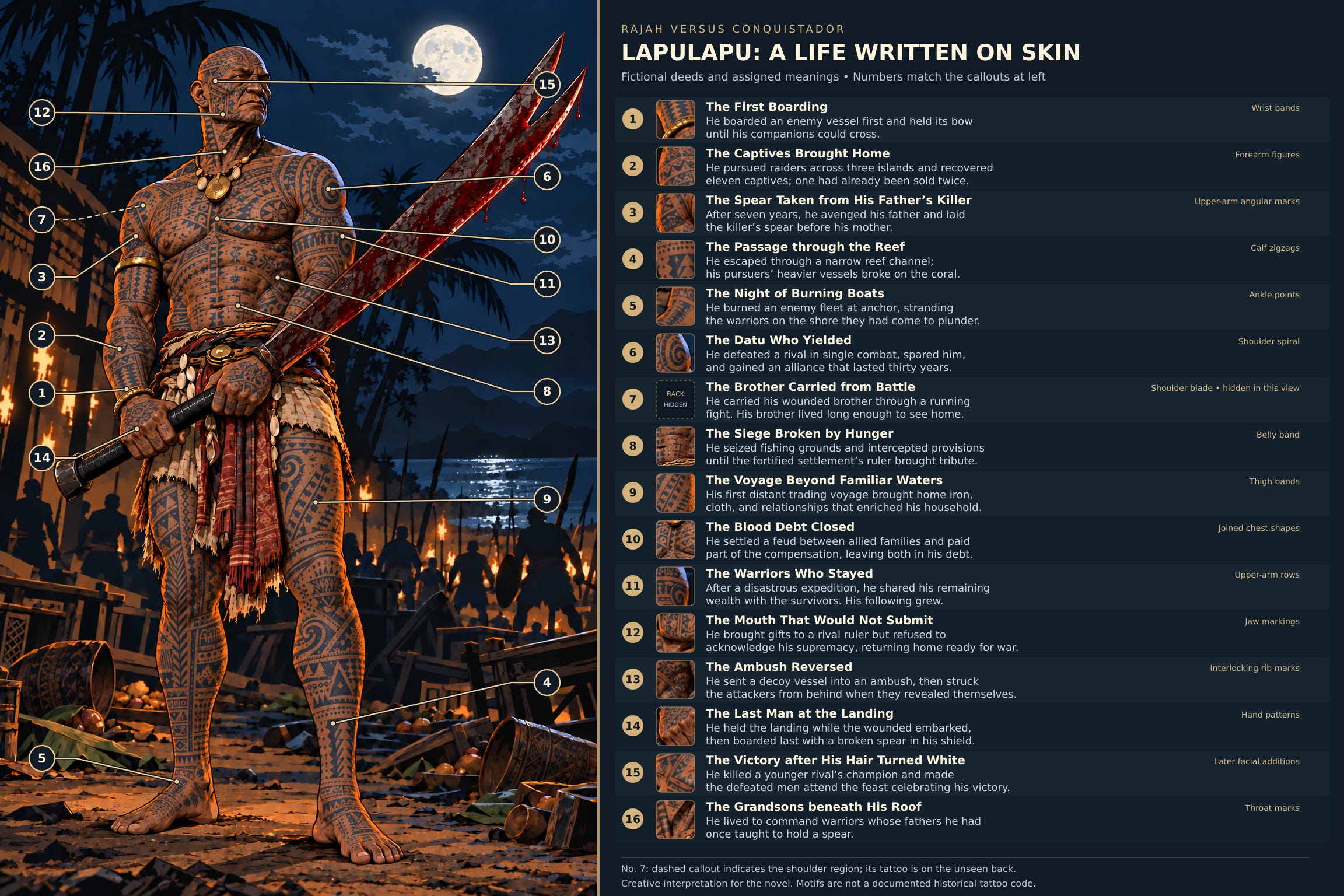
So much for “a real Bisaya man doesn’t care how he looks.” The most feared man in Visayan history was also the most dressed-up man in Mactan.
We lost our tattoos
Our stature no longer depends on the enemies we subjugated and the number of ulipon we have added to our sakop. Instead of tattoos, we now display our wealth and power through fancy cars, palatial homes, and direct access to the biggest big men of the nation. Sensei Resil Mojares spoke of this:
We lost our tattoos. They have either been criminalized or sublimated (as in the case of Indonesians, who no longer wear their tattoos on the skin but in clothes called batik, which is the same word as our patik or body tattoo).
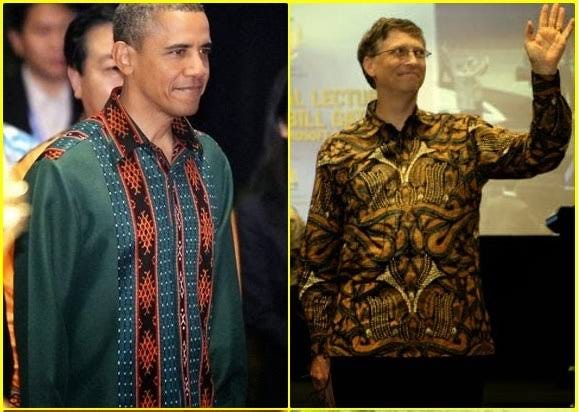
So if the designs on the Indonesian batik are sublimated tattoos, perhaps the designs on the barong could be sublimated symbols of one’s life story as well. A barong as patik. My LinkedIn profile, embroidered.
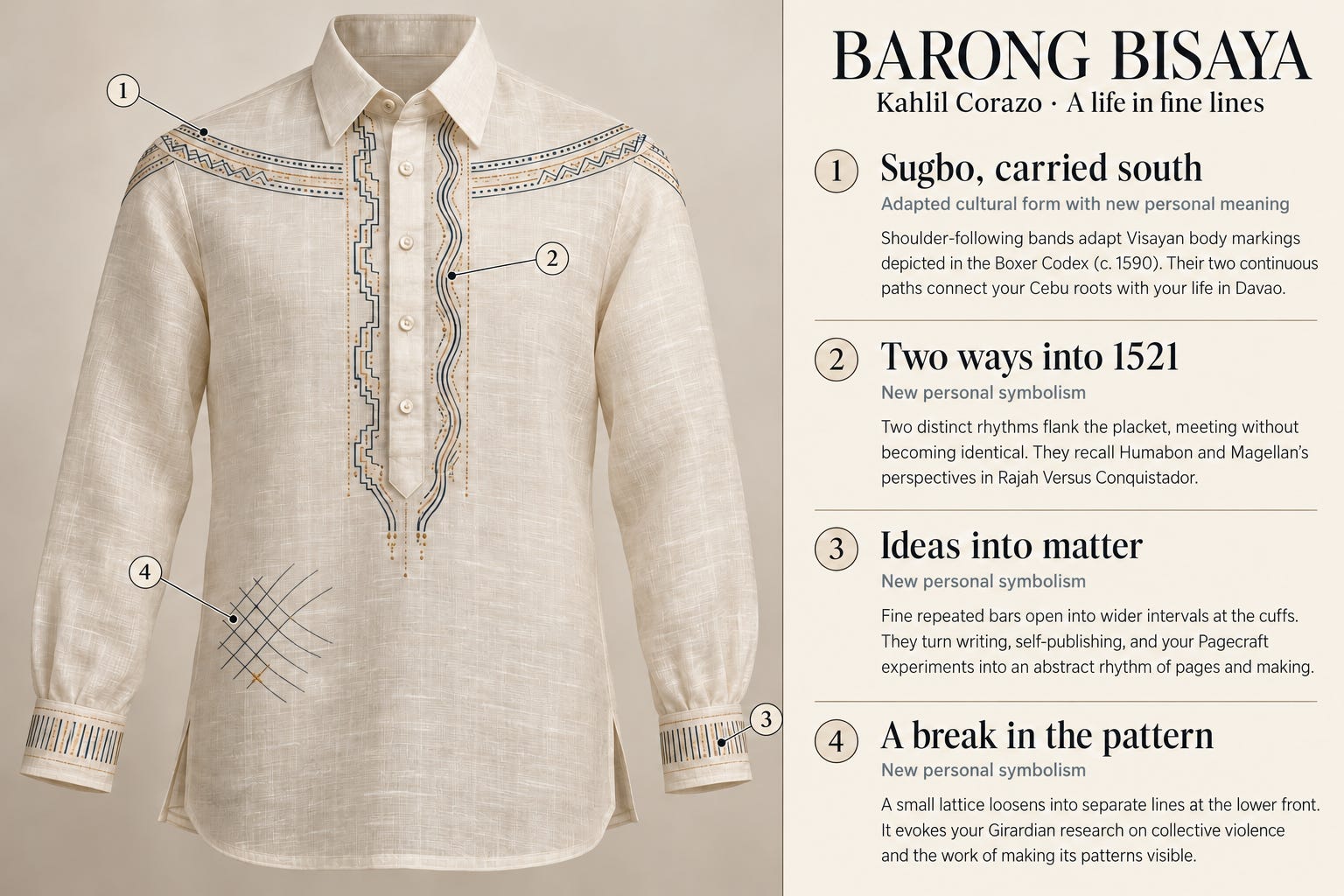
I asked ChatGPT to design this “Barong Bisaya” based on what it knows about me (prompt in the footnote7, so you could try it as well). Here’s the result. Feels a bit cringe, tbh. If ever I’ll have a custom-made barong done, I’ll work with a designer to make something that feels right.
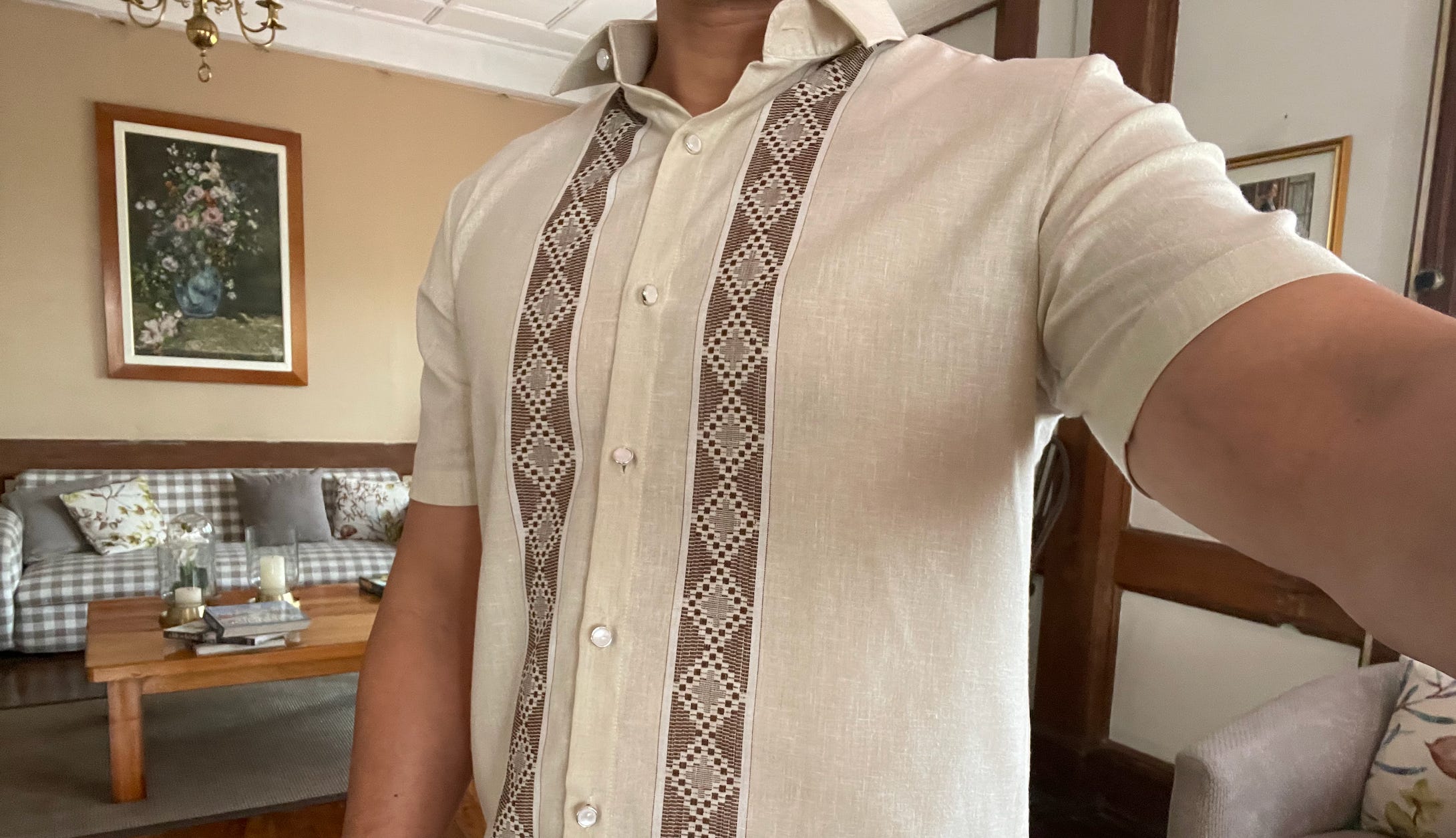
With this in mind, I recently bought a ready-to-wear barong with a patik vibe. It will do for now.
A long-lost relative in Tabasco
Why a barong though and not a Visayan version of the batik? While our roots are Austronesian, those of us who descend from lowlanders in Luzon, the Visayas, and northern Mindanao are undoubtedly hispanized. Hispanized not from Spain, but from Hispanic America.
Barcelona and Madrid felt to me like any other Western European city. Mexico, however, felt like a continuous déjà vu. When I visited Tamazulapam in rural Oaxaca and Comalcalco in Tabasco, it was as if I was transported back to rural Cebu: the same plaza surrounded by the mercado, the tropical gothic church, and the government buildings, with ice cream vendors, tricycle-like transport, tambays, bureaucrats, old manangs selling farm products, and young parents looking after children joyfully running around.
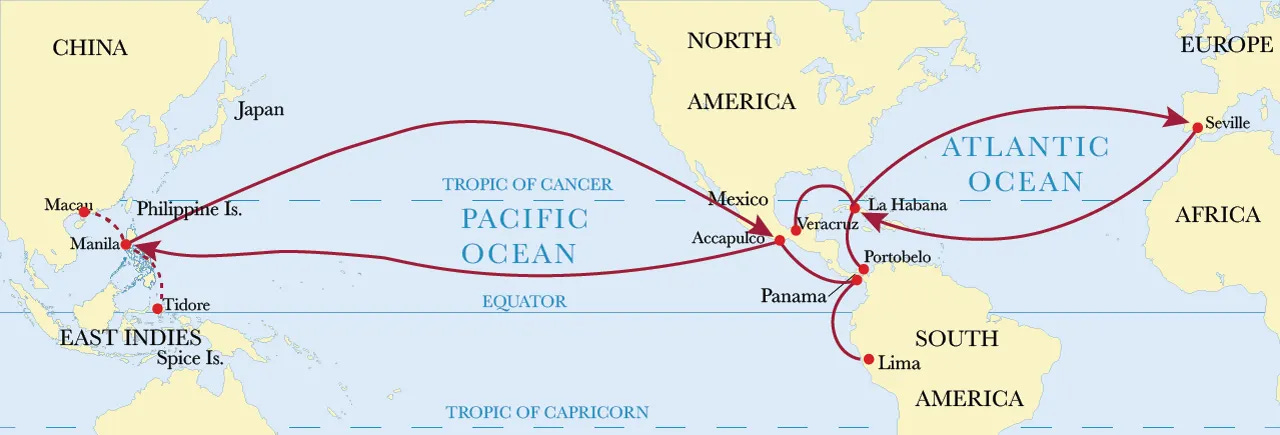
And Mexico City felt like what Manila would have looked like had the Americans not bombed it to the ground in WWII. Our direct connection with Spain only started after the independence of the American colonies and the opening of the Suez Canal. For more than 200 years, we were the westernmost part of Hispanic America.
Walking around the market in rural Tabasco, I saw what looked like barongs. The Mexicans call them guayabera.
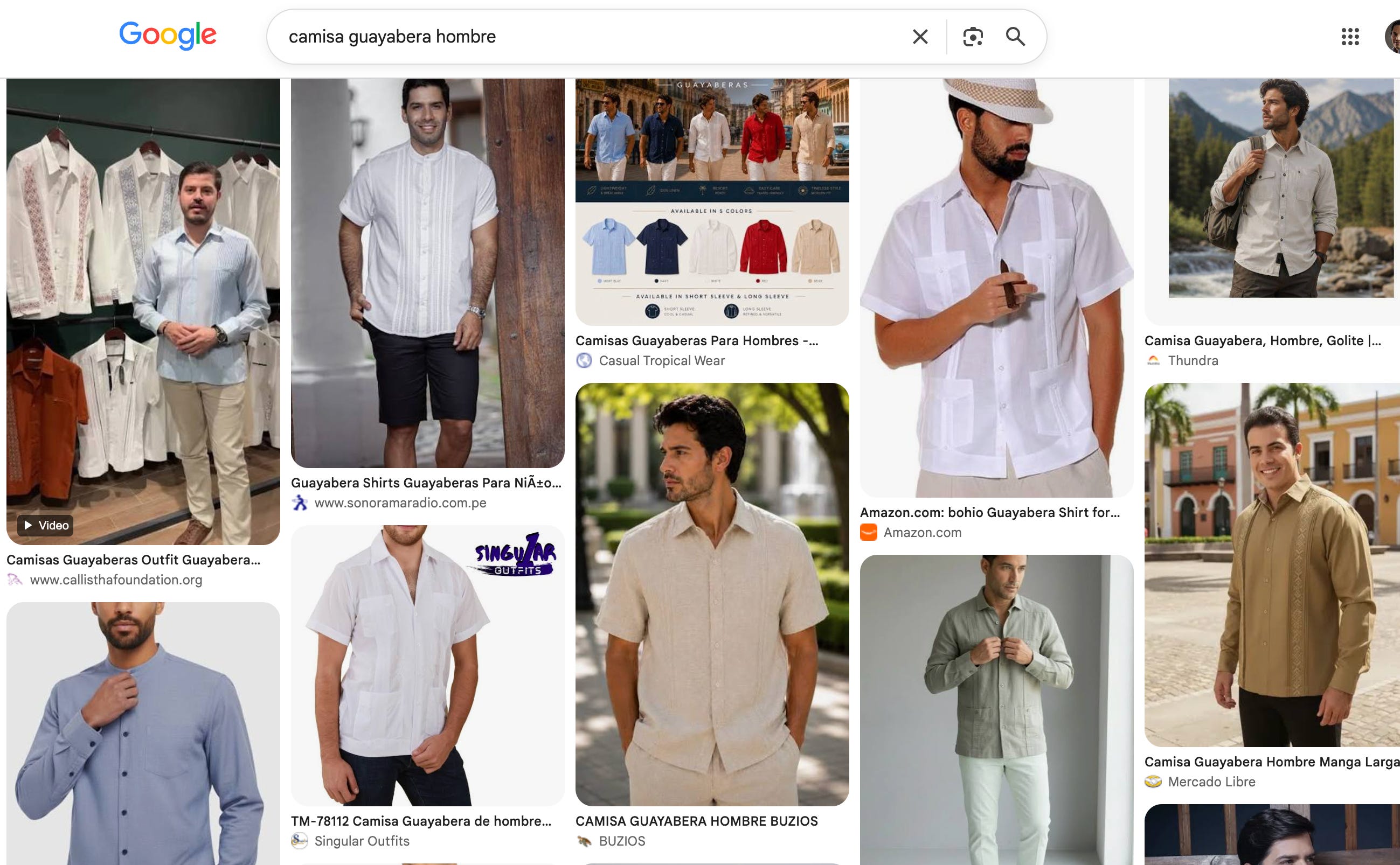
The barong and guayabera belong to an interconnected history of tropical dress; Philippine influence on the guayabera has been proposed, while its documented Cuban development is clearer.8 Whichever direction the influence travelled, seeing those shirts in Tabasco felt like encountering a long-lost relative abroad.
Barong Bisaya
So I’m reappropriating the barong. A barong Bisaya makes sense to me as a garment that carries these layers: Austronesian underneath, Hispanic-American in cut, Filipino in name, and personal in the details.
And when the voice of Filipino machismo whispers “looks gay,” I now have an answer. Lapulapu, in his 70s, faced the conquistadors wearing his whole résumé, inked up to the eyelids. Next to him, my barong is barely trying.
The paper is “Kaagi, Kabilin, Kagamhanan: Anthropology as Method for Re-reading Three Historical Puzzles in 1521 Cebu,” for the 48th UGAT Annual International Conference at MSU–IIT, Iligan City, 18–21 November 2026. The three puzzles: why Humabon turned on his “brother” Magellan, why memory credits Magellan rather than Humabon’s wife with the Santo Niño, and why new converts burned the idols they had expected to heal a powerful man. It’s still a draft, and I’d love your feedback before I present. Read it and leave comments here.
Internet decolonialists tend to attribute the things they like to the precolonial world (eg, kapwa) and the things they don’t like to colonialism (eg, skin whitening). This habit can be traced back to Rizal, the ilustrados, and the katipuneros. For instance, in his annotations to Morga, Rizal built a precolonial golden age that Spain supposedly destroyed: partly true, partly exaggerated, and entirely strategic, a reversal of the humiliation he faced within the Spanish colonial caste system. I wrote about this, via Filomeno Aguilar’s Jose Rizal, Nationhood, and the Anticolonial Imagination, in Rizal Wrote the Playbook for Diaspora Identity Politics. The historical and anthropological record, however, seems to be clear: we can trace most of the traits of our cultures to the local worlds before our contact with the West. Two traits I’m sure are imported: the concept of race and the concept of a nation-state. Ironically, these are foundational (but unspoken) in the internet decolonialist mindset. I wrote a bit about this in Decolonization Is a Distraction from the Real Enemy, and will expand on it in the future.
I only discovered the binukot when I started researching for RVC: the secluded daughters of datus, kept indoors and shielded from the sun. William Henry Scott’s Barangay preserves what I can only call a prehispanic Bisaya joke: “A pig was often raised in the house, where it was reported to be cleaner than a dog, and was called ‘princess’ (binokot) like the secluded daughters of upper-class datus because—like them—it never set foot on the ground.” The binukot started as background research and ended up as one of the novel’s central characters: Paraluman, Humabon’s wife, whose story turned out to be as much the novel’s as Humabon’s and Magellan’s. I tell that story in How the Diwata Got Me to Write a Feminist Novel Despite Being Steeped in Filipino Machismo.
Gaspar Correia, Lendas da Índia, vol. II, chapter XIV, p. 630.
Later Austronesian rulers likewise remained centers of powerful military coalitions in old age: Sultan Kudarat reigned for more than fifty years and died at around ninety; Sultan Nuku of Tidore regained his kingdom at nearly sixty.
Laura Lee Junker, Raiding, Trading, and Feasting: The Political Economy of Philippine Chiefdoms (1999): “In olden times no tattooing was begun until some brave deed had been performed; and after that, for each one of the parts of the body which was tattooed some new deed had to be performed.” Analyn Salvador-Amores, “Batok (Traditional Tattoos) in Diaspora: The Reinvention of a Globally Mediated Kalinga Identity” (2011), describes the tattoos of Kalinga warriors as talismans and “armours,” borrowing Thomas’s phrase “technology of fear.” Kalinga batok is a living analogue, not a direct record of 16th-century Cebu, but it is the closest one we have. I discuss patik more fully in the notes of RVC.
Design a personalized Barong Bisaya inspired by what you know about me from our chat history and verified information about my public work online. Use only information suitable for public sharing.
Translate my roots, work, commitments, and accomplishments into meaningful embroidery—as if the garment carried a life story worn on the body.
Use Visayan tattooing as a starting point, not a boundary. Treat the embroidery as sublimated tattoos: personal stories transformed into forms worn on the body. Preserve the visual force of body-following bands, shapes, and rhythms through fine stitches, subtle colour, and generous empty space.
The design may freely combine researched historical references, contemporary geometry, and newly invented personal symbolism. Recognize that Cebuano culture has become Hispanicized, Americanized, Filipino, and global. Draw on those layers wherever they meaningfully connect to my life. Let them shape a coherent visual language rather than assembling a collection of cultural emblems.
Make the design visibly distinguishable from conventional floral barong embroidery. Avoid generic “tribal” patterns and unexamined borrowing from unrelated traditions. Original motifs are welcome; historical replication is not required.
Research any historical or cultural references you use. Distinguish documented forms from your adaptations and inventions. Do not claim that a historical pattern signified a particular accomplishment unless evidence supports it. Never invent biographical facts.
Choose three to five strong motifs and give them room to breathe. Make the complete garment elegant, wearable, and recognizably a barong. Express personal meaning through the design itself; avoid obvious logos, literal illustrations, and badges. Do not automatically represent religious identity through crosses or other explicit religious symbols.
Required output: one landscape image with two columns.
LEFT — complete barong with numbered callouts
Allocate approximately 60% of the image to the garment.
Show the entire front, including collar, sleeves, cuffs, and hem, with realistic fabric and detailed embroidery.
Use small numbered circles and thin leader lines pointing to the exact corresponding motifs.
Keep callouts from obscuring the design.
Include a smaller back view only if needed.
RIGHT — matching numbered explanations
Allocate approximately 40% of the image to the explanations.
Embed a clean numbered list directly inside the same image.
Give each motif a short name and one or two sentences connecting it to my life.
Label each Documented cultural reference, Adapted cultural form with new personal meaning, or New personal symbolism.
Identify the specific cultural source when applicable.
Use readable typography, strong contrast, and exact correspondence with the garment’s numbers.
Research and finalize the explanation text before generating. Inspect the result and correct unreadable text, inaccurate numbering, misplaced callouts, or unsupported claims.
The connection is plausible, but direct descent from the barong remains unproven. Stephanie Marie Coo, Clothing and the Colonial Culture of Appearances in Nineteenth Century Spanish Philippines (1820–1896) (2014), p. 172, discusses Floro L. Mercene’s proposal in Manila Men in the New World (2007), pp. 126–127: Filipino piña shirts supposedly reached Mexico and were adapted into cotton garments with pockets. This is a proposed genealogy, not an established chain of transmission. Rubén Carrillo Martín, Asians to New Spain (2015), p. 83, instead considers introduction into Atlantic Mexico from Cuba more likely, while leaving possible Philippine influence on the Cuban garment open. HistoryMiami’s exhibition The Guayabera: A Shirt’s Story presents firmer evidence for late nineteenth-century Cuba: an 1896 soldier’s pay book naming a guayavera, a surviving military garment dated 1895–1898, and a photograph from around 1897. These establish the garment’s presence, though its evolution into the modern guayabera remains partly unresolved. Yucatán’s government heritage account recognizes a design called filipina but also describes guayaberas being imported from Cuba toward the end of the nineteenth century. The name is suggestive; without an early dated explanation, it does not establish Philippine origin.
Fabulous pla si Lapu-lapu :)