

This has been read as a complaint 😅 That wasn’t my intent. I continue to be grateful for the help launching the book. Out of ka-ikog, I felt I should offer an explanation—this is my attempt.
I’ve been feeling some shame lately—shame from the use of AI in my novel. The experience is strange. I’m living inside it while simultaneously observing it, suffering through it while finding it fascinating as a scholar of culture. But I also feel a kind of privilege. The anthropologists I admire—people like Malinowski, Evans-Pritchard, Rosaldo—traveled to the edges of the world to study the Other, and in doing so, discovered something about all of us. My frontier is temporal, not geographic. I’m watching a new taboo take shape in real time, and I happen to be standing on the wrong side of it.
Inadvertently polluting a book club
I sent copies of my novel to a book club months ago, and they happily agreed to do an Instagram book tour for it. I’ve been writing about my usage of AI in this blog and I mention it in the book as well, though not announced in flashing neon. When I started using Claude AI for the novel, the cultural script for AI in creative work hadn’t been written yet. Most readers seem genuinely indifferent. But if you’ve hung out the past year or so in the more literary corners of Substack, you would have seen a phenomenon that would fascinate ethnographers: the birth of a new taboo.
This taboo probably reached the book club, because when they read the novel’s acknowledgement, where I thank Claude for its role in the book, many of them chose to opt out of the book tour. Then I made a video relaying how I used AI. After that, all of the book club members decided to opt out.
I want to make it clear that the book club handled this situation with grace and professionalism. Nothing in their communication suggested malice or judgment—they were kind, apologetic even. At the same time, I never saw them mention AI in their social media posts, so I had to rely on negative reactions to AI from elsewhere. To get a quick read on the public language around AI, I asked Grok to report on people’s most common reasons for opposing AI in creative work. The top answers are ethics, job displacement, and authenticity. For something more visceral, check out this scathing review of a local musical that used AI for its songs—the language is revealing: AI is sacrilegious, dangerous, perverse.
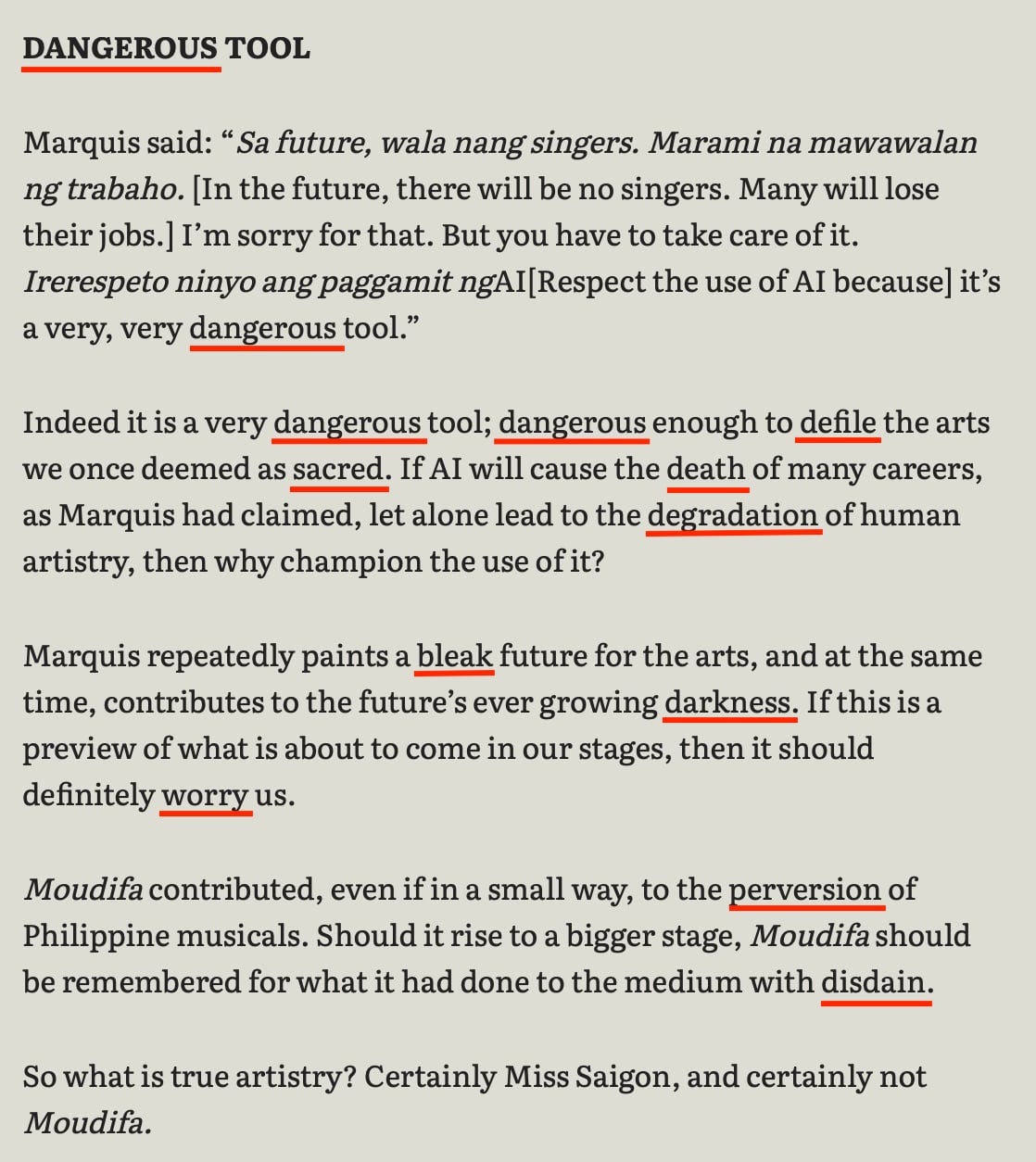
The disruption is real. But I recognize the emotional architecture underneath the reasons. I’ve studied this architecture, and now I’m living inside it.
From shame to language activism to tech optimism
One of my earliest memories of shame was in the classroom. I was in elementary, perhaps around ten years old. Back then, we were punished for “speaking in dialect.” The punishment was sometimes public shaming: having your name on the list of offenders on the blackboard. Sometimes they punished your pocket: you were fined for your violation.
I also remember one time when I was a contestant in a quiz bowl at the open school grounds. The entire student body was there. It was my turn to answer. The question: what is Filipino for “smoke”? When the audience noticed that I did not know the answer to such a simple question, they tried to help me by shouting the answer, “usok.” It sounded to me like the Cebuano “asó,” so I answered with that. The audience burst into laughter. My ten year-old self, who had a self-image of a bright kid, was overcome with embarrassment.
Those memories framed my years as a Bisaya in Manila. That was my first experience of political awakening. I got in touch with language activists, and I even met up with the gentleman heading one of these groups, Atty. Lino Faelnar, at the Manila Peninsula café. Sitting in that hotel lobby, I felt like those young revolutionaries in late 18th century Parisian coffeehouses—dreamers huddled over cups, quietly plotting to remake the world, convinced that ideas could change everything.
It has been many years since. My essays had no effect on the language problem. I’m not sure if Atty. Faelnar’s activism did either. Yet I witnessed something radical happen in Cebu—a transformation that no amount of political organizing seemed to accomplish. Before the 2000s, there was virtually no modern popular music in the Cebuano language. We were singing other people’s songs in other people’s languages. Then suddenly, an explosion: rock bands defiantly performing in the vernacular—Bisrock—followed by a polished pop movement that made Cebuano music mainstream—Vispop. An entire generation began growing up with songs in their mother tongue as normal as breathing. I recount this history in an essay I wrote years later, but I never quite explored what actually caused the shift.
I’m now convinced the answer was simpler than any grand awakening: digital recording technology. The old analog studios were expensive gatekeepers that kept most voices out. Digital changed everything—suddenly anyone with a laptop could produce professional-sounding tracks, and the internet made distribution practically free. The irony is that this same technology devastated musicians in the US and elsewhere. Streaming services paid fractions of pennies per play. The middle class of working musicians collapsed. Yet in Cebu, that same technological disruption gave us something we’d never had: an abundance of songs in our mother tongue, sung with confidence and craft. The floodgates opened not through politics or cultural policy, but through cheaper tools of creation.
I could not find statistics on published books per language in the Philippines, so I uploaded the catalogues of three of the biggest publishers in the country and asked ChatGPT to crunch the numbers. It extracted 121 books from the three docs: 61% are in English, 35% are in Filipino and other Tagalog dialects, and 4% are in other Philippine languages (Kinaray-a, Hiligaynon, and Cebuano). There are more than 170 languages spoken in the Philippines with thirteen or so spoken by more than a million people, but only four can be found in this list, with “Filipino” and other Tagalog dialects representing 90% of the non-English publications.
Writing books has long been a game limited to the educated and the wealthy. You also need a high verbal IQ, and where I’m from, years of training in a foreign language, like English or Tagalog. I’d love to be able to write in my mother tongue. But remember—neither our writers nor our readers have received any formal education on our language despite being taxed by the state like any citizen. LLMs have made translations much easier and the writing of books much cheaper. I’m optimistic that with new technology, we will get more stories and essays outside the urban, educated English- and Tagalog-speakers that dominate Philippine publishing.
My guess is the same thing will happen with AI that happened with digital recording—it will wreck entire industries and livelihoods in ways we can already see coming, while simultaneously enabling forms of expression and creation we never thought possible.
Shame as empathy of the Other’s disgust
You can’t help but become a bit of a connoisseur of emotions when you write a novel. It feels like learning to name flavor notes in coffee. For instance, what’s the difference between cringe and shame?
I’m reminded of that time when I told my writing coach, Mitya, that I was using AI for the novel. I was filled with cringe as the words left my mouth. The best definition of cringe I’ve encountered comes from Venkatesh Rao’s essays on the US version of The Office: cringe is the vicarious experience of lowered status. I didn’t know what Mitya actually thought. But we all carry little models of other people in our minds, and the mini-Mitya in my head—who I must have modeled as a player in the Philippine literary hierarchy—saw my decision as a low-status move. It felt like watching Michael Scott make a fool of himself, except I was the fool.
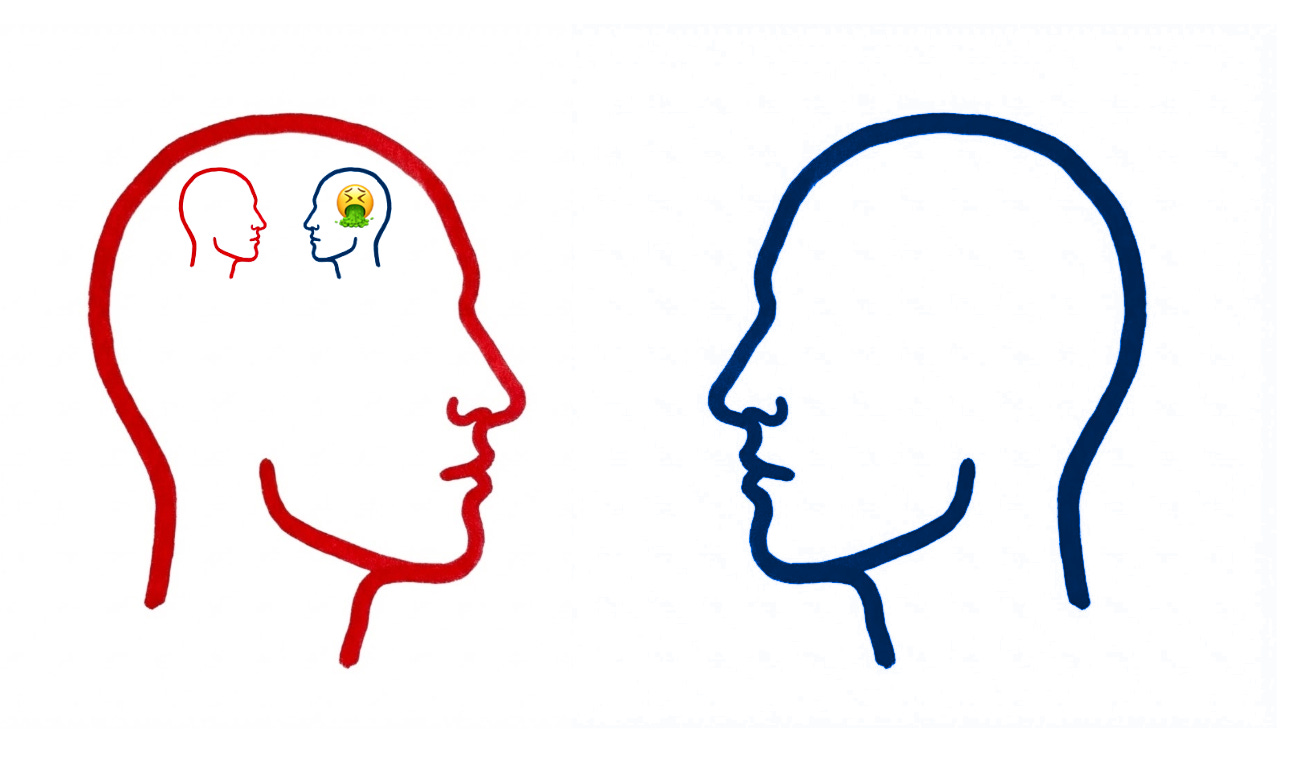
Mitya says to this day that he respects my decision but disagrees with it. When the book was done, he even encouraged me to try writing the next novel without AI. I understood what he was offering—a path back to literary legitimacy. But I’d already chosen a different game.
The evolutionary origin story of both cringe and shame probably comes from disgust. According to Jonathan Haidt in his 2012 book The Righteous Mind, disgust is not just a feeling of yuck; it’s an evolved defense system that scans for pollutants—first in food and disease, and eventually in people and behaviors—and urges us to avoid or eject what seems impure.
Culture evolved on top of biology. Cringe operates as a navigational system, constantly calibrating your desires and actions toward what the tribe considers valuable. When I cringed telling Mitya about using AI, my nervous system was simply processing information: this move doesn’t advance you in the literary hierarchy.
Shame operates in a different register. Shame guards the sacred and the taboo. It’s the alarm that sounds when you’ve touched something untouchable, when you’ve violated not just a preference but a boundary that defines the moral order itself.
Since I’ve been consuming an inordinate amount of anthropology in the past few years, my brain kept flashing “Mary Douglas” as the book club distanced itself from me. Mary Douglas was a British anthropologist whose 1966 book Purity and Danger remains essential reading for anyone trying to understand how societies police their boundaries. Her central insight was deceptively simple: dirt is matter out of place. A shoe on your foot is fine; a shoe on your dining table triggers disgust. Dirt, pollution, impurity—these aren’t objective properties of things but rather violations of categories that cultures have constructed to make sense of the world.
The anthropological and historical record has countless examples of evil things treated as sacred and good things treated as taboo. In the contemporary world, we have seen how the state and dominant cultures have used shame in systemic exclusion of those who don’t quite fit in. So when I experience shame, as I do now, I ask: what cultural force is weaponizing this feeling?
Shame from the inside
This essay is an experiment in a kind of frontline scholarship—thinking from within the experience rather than at a distance from it. Now that AI can search and synthesize dense academic articles in minutes (work that would take me months), I find myself asking: what remains uniquely human in scholarly work? Works of writers like Renato Rosaldo on grief and Sebastian Junger on combat suggest an answer: the irreplaceable knowledge that comes from living inside an experience while studying it. So let me try to describe what this shame actually feels like—something no LLM could do for me.
It is nausea without illness—my body rejecting my social self. I feel marked, as if something got on me that can’t be washed off. It’s the sense that I’ve become embarrassing matter. As if my body is trying to eject me from the room. The feeling resembles impending doom, but less acute, less concentrated at the pit of the stomach—it emanates from the chest and distributes itself throughout the body, settling especially in the limbs. Not a sharp stab but a dull, radiating wrongness.
What fascinates me is how selective shame is about its triggers. I am virtually immune to shaming online. I came of age on the internet, so perhaps I have the antibodies for anonymous hostility—strangers in comment sections are just pixels to me.

I feel nothing looking at that. Yet I’m embarrassed to admit that I’ve lost sleep over this book club incident. I don’t think English has the words for what I’m feeling. It is not just generic shame—ka-uwaw—but something more specific: ka-ikog.1 I have utang kabubot-on2 to these book clubs. And book clubs, at their best, are the purest part of the Philippine literary scene3—otherwise dominated by ideological battles, marketing hustle, and status games. They read because they love reading. I feel like a tourist who walked into a sacred space with his shoes on, tracking mud across the floor, oblivious until the silence told him something was wrong.
Perhaps it’s because I could empathize with them—because I’ve met them. The internet randos are just text and jpegs, but these are people I’ve sat across from. Because of empathy, I carry models of the book club members inside my mind, just as I carried a mini-Mitya. And in those models, I can feel their discomfort projected back at me—their sense that something polluting had entered the space. The shame doesn’t come from people who despise me. It comes from people I respect, whose values I’ve inadvertently violated.
From the interior moral standpoint, shame is like sexual attraction or anger. They are all automatic inner responses to external stimuli, and freedom is found in the gaps between impulse and consent and action. I can’t stop the shame from arising, but I can disagree with it.
My sacred commitment
I asked Grok to tell me the backgrounds of the respondents of the report it created above. It turns out the respondents of the surveys it used are quite different from me. They are affluent professional creatives from the US and the UK, while I’m an indie writer and scholar from the southern Philippines concerned about cultural equality. To be honest, I care a lot about diversity in Philippine publishing and very little about the grievances of the global creative class.
I can only assume that the book club members who withdrew hold values closer to these creatives. My shame—ang ka-ikog—is real. However, I disagree with this feeling of shame, just like I disagree with the shame imposed by the Philippine state on ten-year-old me. I see AI differently.
Literary awards are recognition of the virtuosity of writers; they assume that the work being judged is an authentic representation of this virtuosity. Through this lens, AI is like performance enhancing drugs in the Olympics. I had to make a choice: do I stay within this framework or do I step out of it so the work can exceed my skills, talents, and time? I chose the latter. Writers shaped by the Philippine literary world seem to value their work as an authentic representation of individual craft. I saw the novel differently. To me, it was a project, and what mattered most was achieving the best result as efficiently as possible.
In a sense, AI helped me make the novel more authentic to the vision I had for it. I came face-to-face with the limits of my abilities as a writer in trying to achieve that vision. There were very specific voices and vibes I wanted for the novel. I was able to produce them, but it took me a month for each chapter and it was very exhausting. I was ready to spend four to five years of my life writing the novel, but when I found an easier, faster way, I couldn’t see any reason to say no to it—especially after realizing that I spent more time ensuring that I didn’t sound off-key in this foreign tongue than in actually telling the story. A lot of this work is trial-and-error, revision after revision after revision. Having a machine that doesn’t get tired allowed me to continue being the demanding editor without being myself the overworked sentence manufacturer. I don’t believe that suffering has inherent value, including in creative work. I’ve written previously about how codified knowledge—both in culture and tech—enabled the fulfillment of the desires of more and more people paid with less and less coercion and violence: I’m an “antisacrificial tech optimist.”
Some describe LLMs as glorified autocomplete machines. In a sense, this was how I used it. I uploaded my handmade chapters to Claude and it was able to mimic that voice for the rest of the chapters. The story came from me; I made all the choices in the book’s plot, characters, voices, and structure.
If I ever work with another book club, I will definitely highlight my AI use from the start. This incident was a painful lesson. I didn’t realize how strongly people felt about this—that was naive on my part. I saw it as one tool among many. Others see it as crossing a fundamental line. I should have understood that earlier.
None of the book club members explained why they were against AI beyond it being against the values of their members. They don’t owe me or anyone an explanation, and I continue to respect and admire the work that they do. This post is an attempt at making sense of what happened using the tools I have—anthropology and blogging—but I’m also trying to be clear about where I stand.
A number of people have supported and promoted the novel—reviewers have written about it, bookstores carry it, book clubs featured it. I continue to be grateful for their past support, so I feel that it is I that owe them an explanation. I’ve written above about taboo and the sacred. Let me end with what is sacred to me: I had a commitment to the muse, to the diwata of the story, and I gave everything I had and used every tool I could access to honor that commitment. And I got it done, not without cost. Truth is also sacred to me. That is why hiding my use of AI was never an option.
I’m not blind to the panic and worry rippling through the industry with the rise of AI. These concerns deserve to be taken seriously. But I hope I’ve also made clear where I’m coming from: I’m less invested in preserving worlds many of us were never truly part of than in helping birth new and possibly better ones.
From Claude (I co-sign): “Ka-ikog and ka-uwaw are both Cebuano terms in the semantic field of shame, but they differ in texture. Ka-uwaw is the broader, more general term — roughly equivalent to the English "shame" or "embarrassment." Ka-ikog is harder to translate. It carries a sense of being ill at ease, of feeling out of place or awkward in a social situation — particularly one where you sense you've caused discomfort to others or violated an unspoken expectation. Where ka-uwaw might describe the hot flush of being caught in a public mistake, ka-ikog is quieter and more relational: the shrinking feeling of realizing you've inadvertently imposed on someone's goodwill or transgressed a social boundary you didn't know was there. The closest English approximations might be "abashed" or "self-conscious," but neither fully captures the interpersonal weight of the Cebuano term.”
From Claude (I co-sign): “Utang kabubot-on is a Cebuano term for a debt that cannot be repaid in money or material terms — a debt of the inner self (kabubot-on derives from buot, meaning will, intention, or inner feeling). It is closely related to the more widely known Filipino concept of utang na loob (literally “debt of the interior”), but the Cebuano term foregrounds volition and feeling rather than mere obligation. When someone extends you genuine kindness — particularly kindness they were not required to give — you carry an utang kabubot-on toward them: a felt indebtedness that shapes how you relate to that person going forward. It is less a transactional ledger than a moral orientation, a recognition that someone’s goodwill has placed a claim on your conscience. In the context of this essay, the author feels utang kabubot-on toward the book club members because they had generously volunteered their time and platform to support his work — a gift of goodwill that makes their subsequent discomfort all the more painful to him.”
Feb 25 update: turns out this impression was incomplete. I saw the more hostile side of the book community with the reddit reaction to this post 😅
Thank you for writing this essay. As you might expect, I disagree with you. But I'd like to discuss. I'm seeing her a lot of discussion on how using AI to create literary art impacts the writer, but not a lot about how it impacts the reader. So I'll throw out my thoughts.
I think part of the reason that your book club was so opposed to your use of AI was because it violates an inherent contract that is present in the consumption of all art. When a reader dedicates attention to a book, they are giving something to the author -- they are saying "I believe that the work you have done, these 90,000 words, are worth spending several days of my life on." And because they value their time, they are implicitly asking you to give something in return -- value in the creation of that work. By using AI, which is very widely considered a "shortcut" in art today, you are violating that agreement. You are showing that you do not value the creation of your work, and as such, you do not value the reader's attention. You've implied in this essay (and stated in comments here) that the process is irrelevant to the output in creative pieces. This implicit contract is the reason I disagree. When I read a book or an essay, or study a painting, I expect the author to have given to that work a piece of their soul. I expect them to have struggled through the darker parts of the narrative, to have allowed the work to change them, to have worked hard to get to the root of the plot and tease out something beautiful. It is this struggle that gives their work meaning. Without it, the output is irrelevant, because no heart has been put into it. And if I know that as I read, if I know that this writer shortcut their own suffering, then any meaning I derive from the narrative will be worthless, because it has not been tested against the weight of forcing it onto the page. This battle is what separates a Facebook post from a Substack essay and it's what separates a Substack essay from a novel. When we read something, we ask the author for meaning, and when an author uses AI, they deny us that.
Yes, AI will find a place in all aspects of life as we move into this new world. But the reason so many are against your using it to write a novel is because it subverts that agreement between writer and reader -- that this work is worth spending time on, because the author dedicated every fabric of their being to it.
I think you're misconstruing the real point of writing. This is why AI does ruin the art. By asking "does the process even matter?" Indicates that your focus is leaning towards the "results" of writing.
By using AI in the writing process itself, you're commodifying writing as manufactured product rather than a form of art itself which values the "process" of getting it done...
Just like what Brandon Sanderson said:
"The most important change made by an artistic endeavor is the change it makes in you. The most important emotions are the ones you feel when writing that story and holding the completed work. I don’t care if the AI can create something that is better than what we can create, because it cannot be changed by that creation."
If you treat Writing as an "outcome" it loses its credibility of becoming an art.
This is the same reason why Blatant Copying (Plagiarism) is criminalized but Genuine Inspiration is not.
AI is trained from copyrighted content, and it spits out those content directly from its dataset.
What's the difference of that from a Human writer who was just inspired? A human writer who's genuinely creating something transforms that inspiration from one thing to another.
AI doesn't do that. It mumbles words from direct sources, calculate which word is the most likely to be put next to another word, rather than thinking about meaningful context. There is no mind behind the machine, only numeric parameters.
You can argue that it is always similar to how a Human thought is formed, but humans doesn't need prompts to be directly fed to us by someone for us to think. We can choose to think without any prompts, and we can choose what things to think about.
AI on the other hand is like a conveyor belt of words and content from original sources, mashing them together to create a Frankenstein of a "book".
I think, using AI for assisted research is good, using AI for initial critique for grammar technically could be helpful, but to help you write the prose? Help you rephrase and regenerate something you already made? The art stops becoming yours, the art stops becoming an art.