A lot of you missed the golden years of blogging and it shows. Perhaps you came of age in the wartime era of the internet, when one take on the wrong side of the consensus could destroy your career. Perhaps you were reared inside the brutal world of Twitter and Reddit, where the game is to continue your quest while avoiding the Eye of Sauron.
These risks in the open internet has led to what Venkatesh Rao calls the “Cozy Web,” the retreat into private, ungamified spaces like Discord servers, group chats, and messaging apps where depressurized conversation is still possible.
There are holdouts. For instance, visakan veerasamy’s playbook—that is, living in the open internet as a Friendly Ambitious Nerd despite all the risks it brings—has been an inspiration and a model for me and many others. FAN seems to be the unofficial aspirational vibe of TPOT, a loose intellectual scene that emerged on Twitter in the early 2020s. I experienced TPOT first hand, though somewhat peripherally, since I was deep into an adjacent scene, #Roamcult. It was such an extraordinary experience that I’ll be doing an ethnographic study on it for my MA thesis, which—inshallah—will be the basis for a future book.
I suspect the same dangers that pushed people into the Cozy Web also leached the flavor out of the voices still braving the open internet. You can't develop a voice if you're always bracing for impact.
That’s why this conversation with Lideron Farroe in the comments section of my post on AI shame brought me back to those golden years. Our viewpoints on what it means to be an author clash beautifully, and we are unapologetic about our perspectives. Lideron has a distinctive voice, and the directness with which we express our thoughts is itself a form of trust—we spoke as individuals, not combatants in some culture war. I share a segment of that conversation below, which is relevant to my ongoing exploration of AI in creative work. Since I used AI for my novel, could I even call myself its author?
This is how we used to roll, and—however toxic the internet becomes—this is how I’ll always roll.
What you did is just doing a shortcut.
Yes you may have finished the book itself, but you missed all the other things you could’ve learned from yourself if you wrote it down with your hands on the keyboard.
You missed the opportunity to feel your own tone and voice to bleed on to your writing, because you let the AI to bruteforce the way and use the “variations of English expression of paragraphs you wanted” that the AI have created.
You missed the opportunity to learn your own tone, your own voice and your own agency to write the words yourself.
You may have the “deciding power” of what paragraphs to include in the book, but those paragraphs, no matter how grammatically correct or high falutin those paragraphs are, do not have your inherent soul.
The AI had the rough picture of your Idea, collected the right words from the noise of its dataset to form the closest thing that you wanted based on your inputs... But it’s not YOU.
YOU, the artist, is the point of creating an art. You are crystalizing your own thoughts to a text that expresses pieces of yourself to the page.
You should’ve just written the Book in Tagalog or Cebuano if you’re severely having a hard time writing the Paragraphs to English, and then fix the draft after.
The point of art is not about making it good the first time, the point of art is doing the process despite the fact that it’s not practical, nor easy... Yet satisfying in the end, or as how Oscar Wilde put it:
“We can forgive a man for making a useful thing as long as he does not admire it. The only excuse for making a useless thing is that one admires it intensely. All art is quite useless.”
You took a shortcut, and learned nothing but how to prompt the AI correctly. You became a prompter that asked the AI to assemble the book for you.
“This suffering might explain why I have no desire to go through that experience again.”1
If you didn’t like the process of writing the book by yourself, why create one? Why make something and call it yours if you’re not the one that made it?
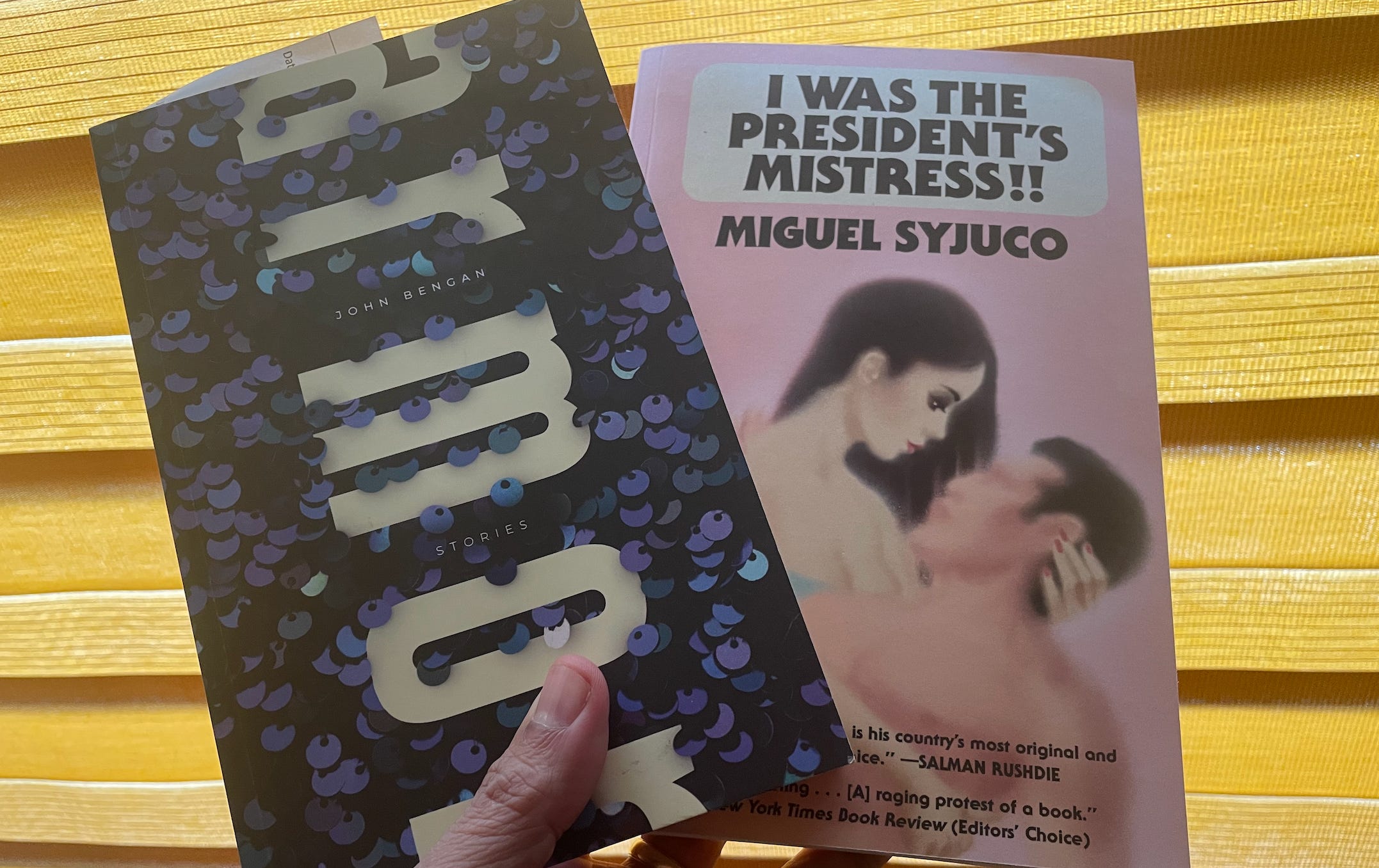
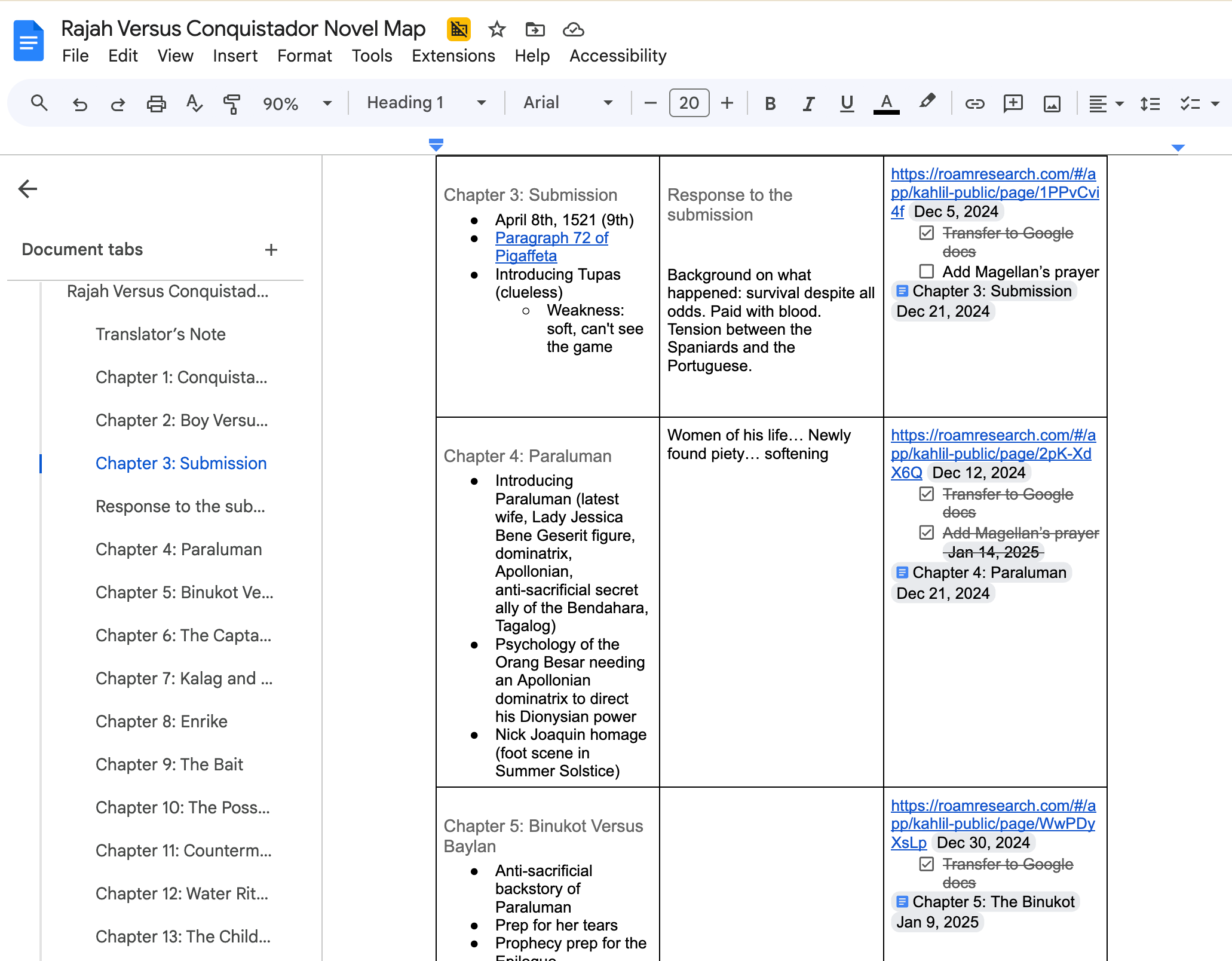
Below is my reply, verbatim—grammatical errors and all. I've added a photo of the books I mention and a screenshot of the “novel map” that I link to.
I always found it curious when people ask me who I am among the characters in the novel. I think your comment points to the spirit behind this question. It is true that writing a lot allows you to find your own voice. Since I’ve been blogging since the word blog was invented, I think I found my voice many years ago. It’s the voice I use in this blog. If you read my posts in Medium from the 2010s, I’ll think you’ll notice a consistency. I’d describe it as janky, meandering, earnest, and a bit nerdy.
This voice—my default literary voice—however, was not what the novel wanted for itself. I knew what that voice it wanted was, and with effort could produce it. I have in front of me rn John Bengan’s Armor and Miguel Syjuco’s I Was the President’s Mistress!! These are displays of literary virtuosity, particularly in the crafting of voice. These writers are like the Hidelyn Diazes or the Alex Ealas of Philippine literature. They are gifted and have honed those gifts consistently starting at a young age. It is a great pleasure to see their handiwork. They deserve their literary awards.
I think writing is like the Olympics. There are many different events, each with its own definition of excellence. I don’t think I’m playing in the same sport as Bengan and Syjuco. In their world, the sounds of the sentences themselves is the work of art. There are other kinds of writing where these sentences are simply channels of the other kinds of excellence the writing is attempting to achieve. This is how I viewed Rajah Versus Conquistador. The sentences were intended to be conventionally good, but nothing that would impress readers or win literary awards.
However, it is still ambitious in other areas. If you compare other historical novels on 1521, I think my book has the chance of winning the gold medal in terms of research. The weaving of worldviews through the two perspectives and the characters that we hear through them is also something I’m quite proud of, though I sense that very few will notice it. Most writers in this space are trapped within the epistemologies of Nationalism and Christianity. You can’t imagine the difficulty of the mental surgery needed to de-Christianize and de-nationalize ones mind.
You mentioned in a previous comment that you think it is okay to get some ideas from AI but not in the crafting of the sentences. What RVC required of me was the opposite. Any idea from AI was a threat to what the novel wanted to be: to be maniacally faithful to the historical and anthropological record, while being as wild as possible in the plot, and also still producing a suspenseful story; to have extremely varied psychologies and worldviews for the characters, consistent throughout the novel, but to also have a conversion arc for the main characters; to be free of the oh so common anachronism of using the past to promote “moral lessons” for the present, but to also use the present to make sense of and “translate” the past. This was the real game for me. It was like 4D chess. It entailed a lot of mental anguish but at the same time I feel this was the game I was born to play. This novel map gives you a sense of the game I had to play: https://docs.google.com/document/d/1Fz21LWhYn0p7fqqIWWqVoC8CGm7Urk3dnKazvABg_HM
I understand the ideals you hold for the act of writing: it is a path to discovering yourself and your literary voice; the complete artistry of expressing your soul through the choices you make at all levels—from each word, to the plot, to the stucture, to the voice; and each word, each choice, paid with suffering. Yet the experience of writing is I’m sure rich enough that could hold varied ideals and kinds of writers. The act of writing can also be an escape from the self; the artistry can be in the weaving of worldviews instead of words; and the outcome—the book itself—can be treated as more important than the experience, the writer’s feelings about it, or his transformation through it.
I used AI for RVC the way T-Pain uses autotune. To me, producing the right voice was a procedural craft, not a mystical art. The story would have been the same without Claude, Roam Research, or Readwise; though translating that story into a fun and layered novel would have taken me much longer (four years longer in my estimation) and probably wouldn’t have sounded as good. So I have no doubt that the story is mine—or at least I was its conduit to this world.
A thoughtful and nuanced defence. This kind of expenditure of energy is necessary to reach a more considered position on the many ways AI can be incorporated or excluded from creative processes.



A thoughtful and nuanced defence. This kind of expenditure of energy is necessary to reach a more considered position on the many ways AI can be incorporated or excluded from creative processes.