

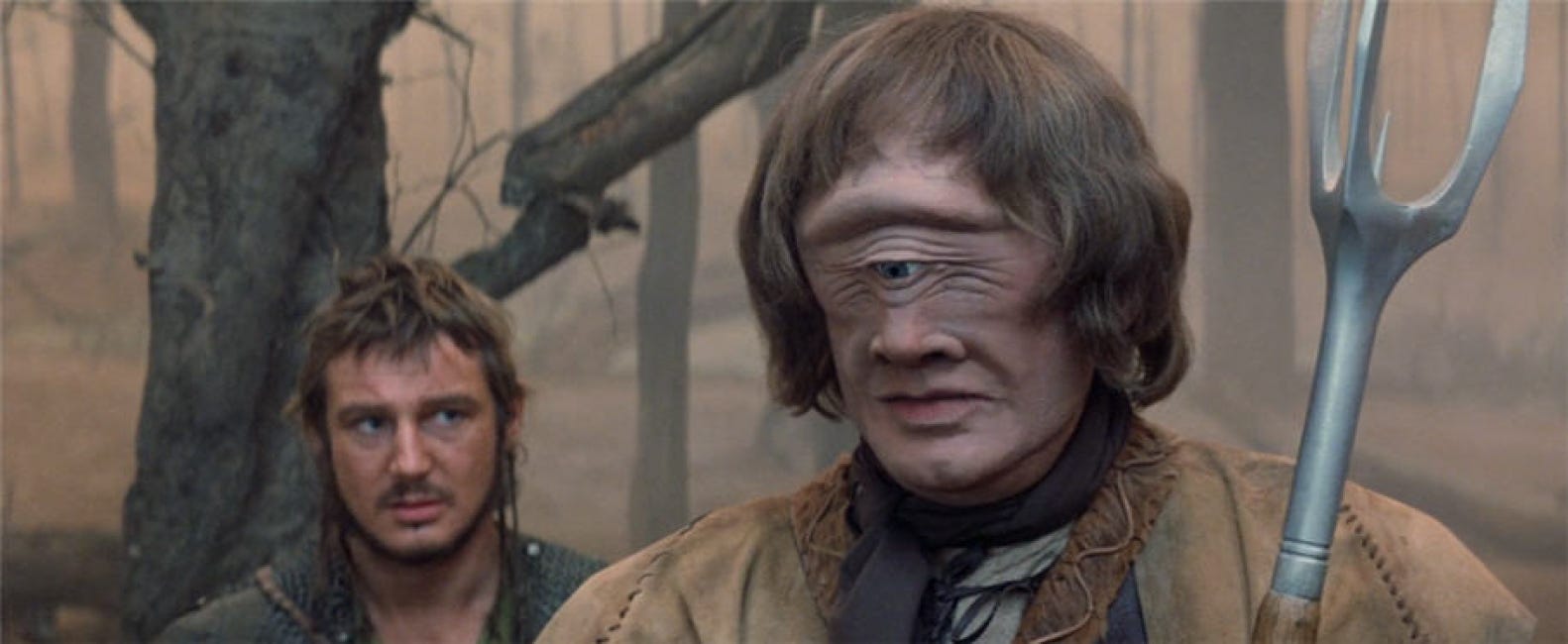
In Krull (1983), the Cyclopes made a deal with the Beast. They gave up one eye in exchange for the power to see the future. They failed to read the fine print: they ended up seeing exactly one thing, the hour of their own death.
Five hundred years ago the West made a similar deal with the creature called Science. They gave up their vision of the enchanted world in exchange for mastery over the material world. The deal was a good one. The eye that remained sees deeper than any eye before it. But it sees one kind of thing, and everything else, including the creature it made the deal with, has become invisible.
This is part II of Psychofauna Studies. Part I — Psychofuana Studies: A Neo-Animist Manifesto — claimed that large cultural forces are living things with agency but without consciousness. It also profiled two of these creatures: Technocapital and the Philippine nation-state. In this second part, I’ll present a mechanism that works with both biological and memetic life. Then I’ll profile three other psychofauna to explore the nature and limits of neo-animism: Science for its epistemology, and memetic Jesus and Satan for its dangers. These are my lessons from practicing neo-animism since writing Part I.1
Life is Antifragile Information
I wrote this thread more than six years ago, back when X was still Twitter. It is now a relic from the pre-AI era, when thoughts could remain at their seedling stage for years. Here are some excerpts from it:
1/ Life Is Antifragile Information Traveling Through Time Using the Fragility of Matter as Its Vehicle - a Naive Take
3/ Non-living things carry information. Information carried by a rock, for instance, could tell a rock scientist (petrologist, it turns out) what the rock is made of, possibly how it was made, and perhaps when it was made.
4/ It appears that in non-living things, information degrades over time. A rock made today contains more information than its time-worn version in the future (eg, silt).
6/ In living things, information appears to retain its fidelity across time. For instance, the huge amount of information used to produce living bodies—the genome—is largely conserved through time. Human bodies 250,000 years ago are not that different to ours today.
7/ What do living things have that non-living things don’t? 7.1 The information they store is received from predecessors and passed on to descendants. 7.2 They translate this information into bodies
8/ cont. 7.3 They use these bodies to replicate the stored information... in a way that increases the effectiveness of information storage and replication. That’s essentially evolution.
9/ “Antifragility” was coined by Nassim Taleb to describe things that gain from disorder, like human bodies (needs some stress to grow stronger) or cities (those that overcome challenges become greater).
10/ The information stored by living things can be called antifragile. As bodies decay and die, the information stored within them become better at replicating themselves.
12/ It appears that information is either degraded by time (eg, information in non-living things) or information uses the degradation brought about by time to travel through time (eg, the genomes of living beings)
The thread continues with links to articles and books I planned to read to make my understanding less naive. In case you’re interested in this topic, the best one I’ve read was Why Information Grows by Cesar Hidalgo (ht Kpaxs). Hidalgo’s argument is that information isn’t ethereal but physical: it’s knowledge encoded in matter. And that the economy is simply the collective system by which humans make that order grow against the universe’s steady march toward disorder.
In Part I, I took the Talebian route, presenting how we can recognize and work with these creatures. I’d like to take the Hidalgo route here, and present a mechanism behind the living nature of psychofauna — to convince you that neo-animism is not only useful but true. I attempted something like this in Durkheim on the Nature of Psychic Megafauna, but this time around I’ll be riffing off Hidalgo instead of Durkheim.
Mechanism
Let’s speculate on the components of living things as antifragile information moving across time. The following seems to be the minimum they need to function as such:
A record of its design
An ability to vary its design
An ability to rearrange matter to increase chances of survival and reproduction of the information’s vessel2
Let’s draw that:
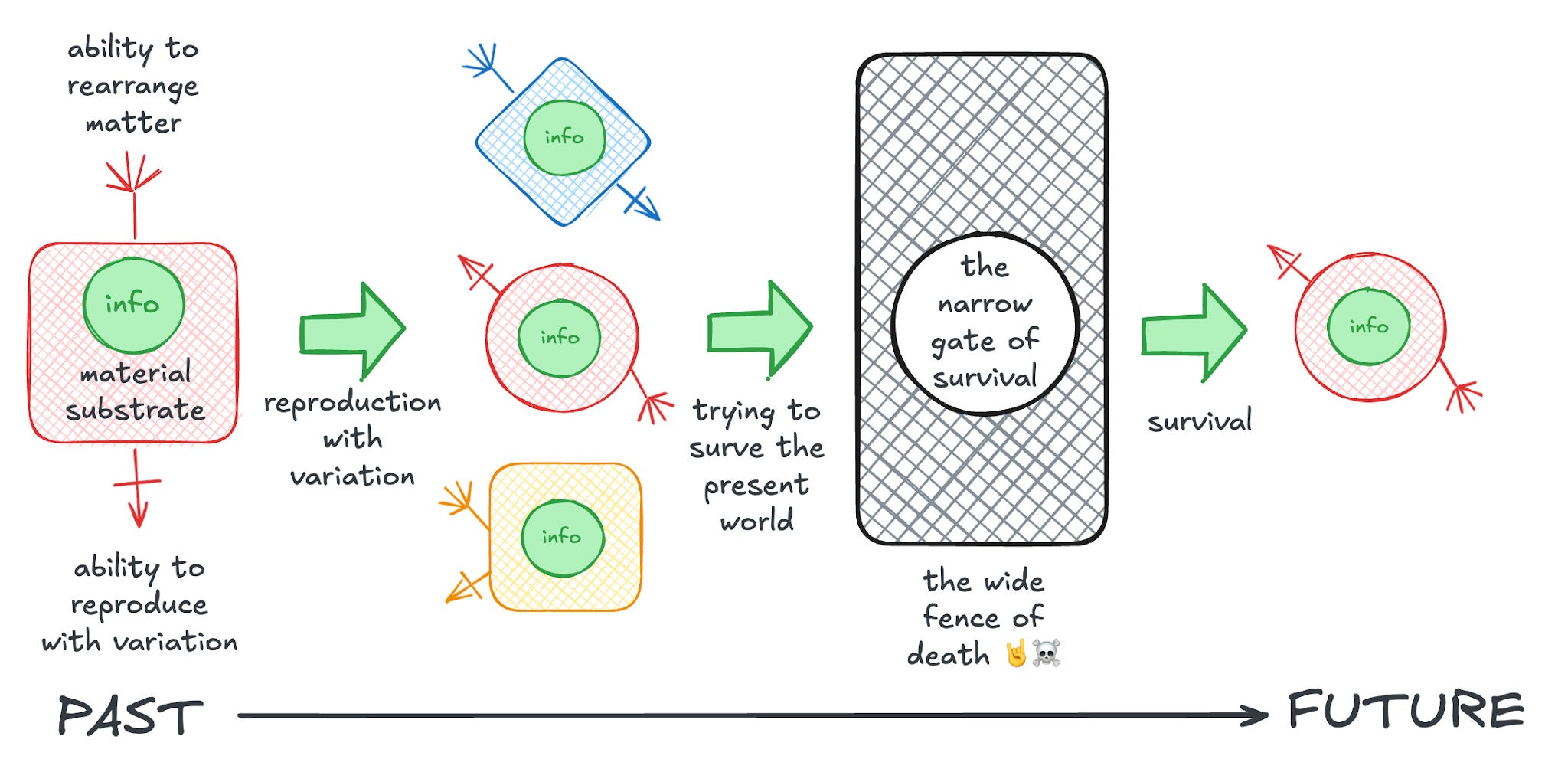
In biological life, this is what scientists call the Modern Synthesis. Claude, explain.
Yes, boss.
In biological life this loop — record, variation, survival, repeat — is the Modern Synthesis, the 20th-century fusion of Darwinian selection with Mendelian genetics. What’s easy to miss is that the synthesis is a bookkeeping system. It specifies what a population must do — carry a heritable record, throw off undirected variants, get filtered — without specifying what the record is made of. Dawkins noticed and gave us memes; Hull generalized it to replicators and interactors; Boyd and Richerson built it into a theory of cultural transmission. The door has been open for decades. Your psychofauna walk through it further than any of them were willing to go.
Why, though? Since writing part I of Psychofauna Studies, I’ve been wondering why Dawkins et al seem to be blind to these creatures, why they don’t walk through the door. Could this blindness be the tradeoff they made with the psychofauna that gave them their superpowers?
Possessed by Science
My guess is the bargain I opened with: disenchantment in exchange for mastery of the physical world. The world became the corpse of a dead angel — a body we could dissect, experiment on, and engineer against.3
Every society has its taboos — actions that go against the interests of the psychofauna it made its deal with. Forager tribes have them; so do modern academic communities. Look at what happened to memetics.
Dawkins coined “meme” in 1976 to give cultural transmission a Darwinian mechanism, then spent the following decades limiting the ambitions of the field it spawned — not denying that memes replicate, but insisting that his proposal was a speculative illustration of Universal Darwinism rather than a theory of culture. Imagine what would happen to him if he publicly acknowledged these beings as real. Actually, we don’t need to imagine. Claude, tell us how memeticists became the butt of Science’s jokes.
Yes, chief.
Memetics didn’t die of refutation. It died of embarrassment, which is a different and more instructive thing. The field got its own journal in 1997 and closed it in 2005 for want of submissions anyone wanted to print; its editor, Bruce Edmonds, wrote the obituary himself, under a title announcing that the gene-meme analogy had turned out to be impoverished. Outside the field the verdict was less polite: an oncologist called it pseudoscientific dogma, and a chapter on memes duly appeared in the Skeptic Encyclopedia of Pseudoscience, filed alongside dowsing. Then the stigma spread to anyone standing nearby. Kate Distin published The Selfish Meme in 2005, wrote a second book on the same subject six years later, and titled it Cultural Evolution — “meme” confined to the bibliography and to an appendix explaining that readers would no longer accept it. Meanwhile Boyd and Richerson, doing recognizably the same work under the name dual inheritance theory, with fewer ontological commitments, kept their standing entirely. That contrast is the whole lesson. What got punished was never the claim that culture evolves. It was the claim that the things doing the evolving are things.
Why would Science deploy the oldest communal response to taboo-breaking — ostracize and banish — when it could have simply disproved, or ignored? ChatGPT, your turn. Find communities that punish one act severely while tolerating a look-alike, and find the scholars who explain the difference.
Yes, sire.
The pattern is not about the act; it is about the actor’s relationship to the community. Medieval Christendom could tolerate a Jew who had never professed its creed while burning a Christian heretic. A state executes an enemy spy and decorates its own officer for the same work. A regime hangs rebels as traitors; if they win, they become founding fathers.
Lewis Coser came closest to explaining this. The enemy stands outside, the apostate leaves, but the heretic remains inside while offering a rival interpretation of the group’s highest values. He is the most dangerous because he introduces alternatives where the group insists there are none. Punishing him does more than remove a threat: as Durkheim and Kai Erikson argued, it publicly redraws the community’s boundaries.
The taboo was ontological. Science could say that humans transmit culture. Memetics suggested that culture transmits itself through humans. The first keeps the scientist outside the specimen jar. The second puts him inside it. Ridicule became Science’s bloodless form of expulsion — marking the carrier as unserious while allowing the useful parts of the mutation to return under cleaner names. Science did not merely kill memetics. It digested it.
Taboo guards the sacred — the psychofauna’s vulnerable beating heart — and memetics hit too close to Science’s. My academic training has mostly been that of a hard science supremacist, so I sensed the taboo as I drew near it. It wasn’t merely the lack of falsifiability; it was what lay behind it: the lack of individuation. Genomes are contained within bodies. The borders are clear. Individuation comes before measurability, and measurability before falsifiability. I tried to find the borders between psychofauna but could not.
From a distance, we can make out the large creatures — Technocapital, nation-states — as we did in Part I. But how do you make sense of a corporation? Is it an organ of Technocapital or a separate entity? How about Family? Womanhood? Agriculture? Language? A particular language? We have no instrument calibrated for creatures without membranes.
Science is allergic to fuzzy borders, even its own. Biology’s units are far messier than the textbook lets on; Science handles this by defining workable units and treating the ambiguities as special problems. Pando, the aspen grove in Utah, is more than forty thousand stems and one genetic individual. A Portuguese man o’ war is a colony of specialized zooids functioning as an animal. Our bodies carry roughly as many bacterial cells as human ones. “What is a species?” remains a permanent problem in the philosophy of biology, and it stops no one from working in the lab and in the field. These are rulings, not discoveries. Someone decided that forty thousand stems count once, and the decision held. Science needs such decisions because selection is a bookkeeping problem: population genetics, epidemiology, every measure of fitness requires an answer to how many, and none of them will run on a continuum. Science can name the occasional monster with forty thousand bodies. What it cannot admit is a world made entirely of monsters — creatures nested inside creatures, with no skins to tell us where one god ends and another begins.
The heretical memeticists were not neo-animists. If they were, they would have recognized that they were possessed by the psychofauna they were desecrating. They played by Science’s rules — journals, conferences, peer review, tenure — and wanted Science’s rewards: scholarly recognition, the imprimatur of rigor. Yet they were undermining the creature they had made their deal with. They were spat out like a poisonous foreign body because that is what they were.
The best scientists are the ones completely possessed by Science, the way the best entrepreneurs are completely possessed by Technocapital. The Cyclopes’ monovision is both a weakness and a superpower. The best depiction I’ve seen of this is David Foster Wallace’s “How Tracy Austin Broke My Heart,” which shows why the people most gifted at a thing are structurally incapable of telling us what it is like to do it. The blindness and dumbness, Wallace writes, are not the price of the gift; they are its essence. To fully serve a psychofauna is to lose the distance required to see it. The scientist who can describe Science from the outside is already only a partial scientist. The entrepreneur who can name what Technocapital wants from him has already hedged his devotion.
We’d want scientists to stay possessed by Science, so they can keep doing good for humanity. They should collect their prizes, and the prizes should stay meaningful. Freedom from possession may cost you your shot at virtuosity. It is best for artists to stay possessed by their muses, at least while they’re doing art. Exorcism might even threaten mere competence; I don’t want my accountant to be a jazz musician while he’s going through my numbers.
At the same time, I meant what I said in Part I: Psychofauna Studies is firstly a weapon of defense. Possession is only safe when the possessor is benign, and not all of them are. The worst things humans have done to each other were not done in spite of devotion but through it — by people fully possessed, collecting their rewards, certain they were following the voices of gods. That was our past. A world in which people saw spirits in everything, negotiated with them, fed them — and what that world built was not the enchanted harmony we like to imagine. It was an ancient derangement, bloody enough that climbing out of it took several thousand years and is arguably still unfinished.
Memetic Jesus Versus Memetic Satan
Since we’re already in Science’s forbidden territory, might as well go all the way. Let’s talk about Jesus and Satan.
My biggest project since writing Part I of Psychofauna Studies was Rajah Versus Conquistador, a novel that enters the mind of Rajah Humabon, the 16th century ruler of Cebu who allied with Ferdinand Magellan and later orchestrated the battle that led to the famous navigator’s death and, after a few days, the massacre of two dozen of his remaining men.
To faithfully depict Humabon and make sense of his actions, I had to exorcise my mind of the psychofauna that have entered the Cebuano noösphere in the past centuries. Tom Holland (the historian, not Spiderman) and Nietzsche (through René Girard) helped me see the changes in the water that we swim in today. The biggest was clearly Christianity. The following now feel like they were forever part of our world:
The radical equality of all
That we should side with the weak instead of the powerful
That Truth should prevail over the fears of Harmony or the desires of Power
Yet, if we look at that world with unfiltered eyes, we see both the familiar — the fiestas, the centrality of family and friendship, the patronage of the powerful and the subservience of their followers — as well as the strange — a political economy based on slave-raiding, ritual human sacrifice, and sociopathic rulers covered in tattoos and golden ornaments.4 In my Girardian academic article “The Scapegoat Mechanism in Southeast Asian Ritual, Myth, and Politics,”5 I present how contemporary expressions of power (e.g., Duterte’s rise to the presidency and his drug war) are structurally very similar to the Big-Man-led polities of the Austronesian expansion throughout Southeast Asia. The seeming invisibility of this connection as well as of Humabon in official Philippine history points toward our possession by Jesus as well as the Philippine nation-state.6
This is my other hesitation about neo-animism, the one that has nothing to do with Science’s taboos. Will this awaken old demons? Or is revealing them somewhat protective? Let me first show you the demon.
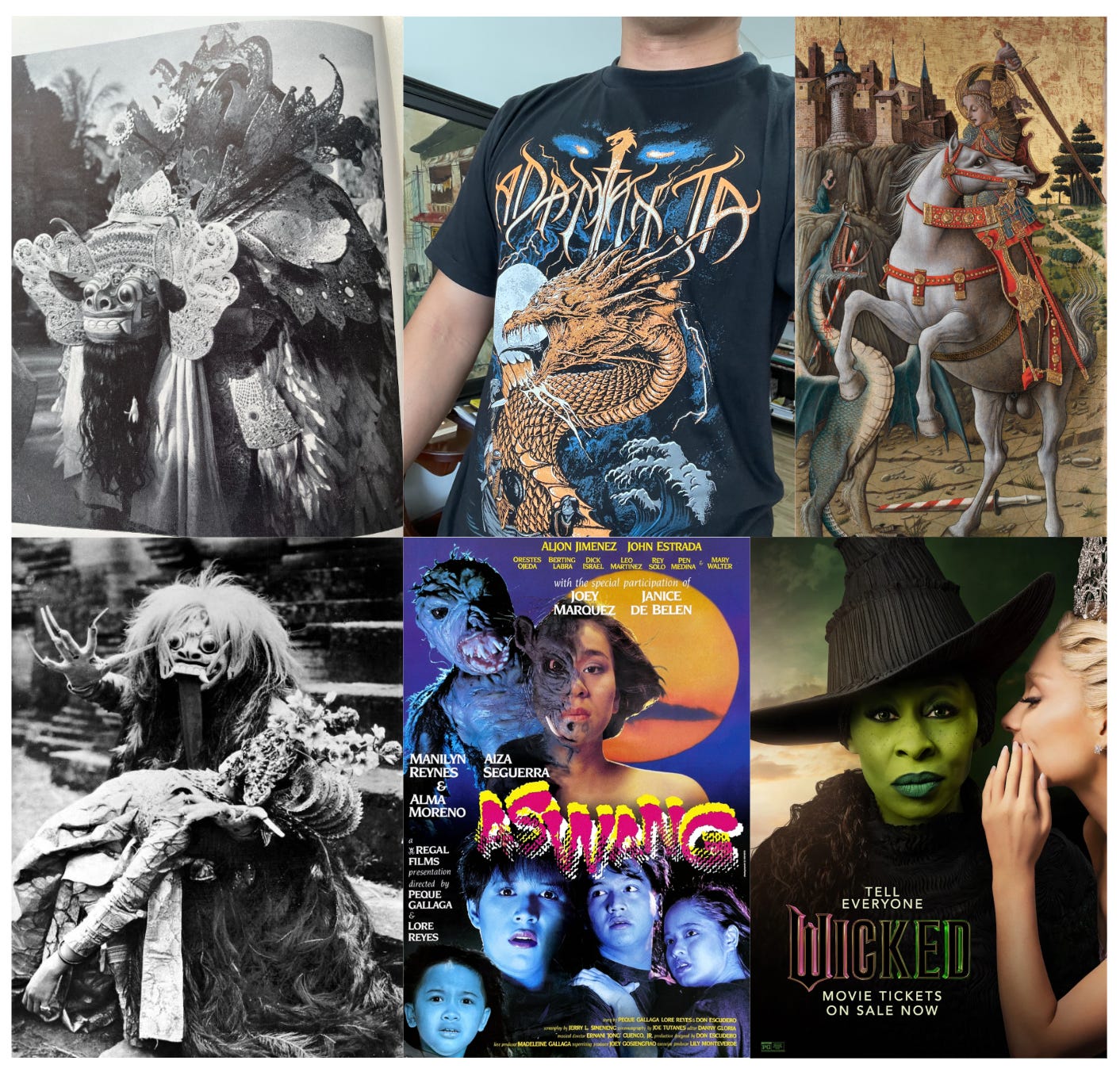
My ancestors practiced ritual human sacrifice (like yours). It was on a much smaller scale than in Mexico, and being Asians with supreme respect for our forebears, we’ve successfully hidden it from the general public. Spending the past few years reading myths through Girard’s lens while practicing neo-animism made me notice how our ancestors and other Southeast Asians depicted the psychofauna that demanded these sacrifices. It tends to be a giant serpent: the Bakunawa of the Visayans, who swallows the moon; Barong of the Balinese; the dragon of Mount Kanlaon. Put on the Girard-inspired psychofauna glasses and you find that the ancestors of the Europeans saw the same creature: Moloch, St. George’s dragon, Satan. Two hemispheres, one psychofauna. Cebu and Bali and Cappadocia drew the same thing because they were looking at the same thing.
If you can’t imagine sacrificing a few people who are unlike you for the sake of your loved ones, then perhaps you are completely possessed by Jesus, which is probably a good thing. Put on the neo-animist lens, however, and you might notice that people in power tend to be possessed by the ancient serpent instead. It has the opposite logic: max out sacrifice to max out power and wealth. The mechanism is what I call dark alpha. In finance, alpha is the spread you capture because you know something others don’t — the investor’s return on superior knowledge and information. Dark alpha is the spread you capture because you are not bound by taboos that bind everyone around you. Prior to the scientific revolution this was most of what wealth-getting was, because in a world where the pie does not grow, the only way to have more is for someone else to have less. The serpent is the creature. Dark alpha is how it eats.
It did not stop eating when the Europeans arrived with a God who was Himself a victim of sacrifice. Chapter 20 of Rajah Versus Conquistador, “Apollo Versus the Crucified,” puts Magellan in his cabin the night he begins to suspect that the spirit he has been serving is not the one he thought. He had stopped a ritual sacrifice days earlier and congratulated himself; now he looks at his own logbooks — the quartering of a mutineer, the marooned priest, the sodomized cabin boy thrown into the sea — and sees the same appetite fed with better paperwork. The dragon that demands blood on a stone altar and the dragon that demands it under proper procedure turn out to be the Dionysian and Apollonian subspecies of the same animal.
To Girard, the writers of the Bible were — using our language here — animist: “Satan,” in his interpretation, is a cultural force that unites a society in its hatred and violence against a designated person or minority. He has an evolutionary explanation of how this became a kind of collective instinct in humans.7 This instinct, which he calls the scapegoat mechanism, is an astonishingly good explanation for the ubiquity of ritual human sacrifice in antiquity; the presence of witches, dragons, and victim-gods in myths across the world; pogroms throughout history; and the effectiveness of scapegoating in contemporary politics.8
Girard was a believing Catholic. When speaking as an academic, however — as far as I could tell — he consistently played within the rules of academia. As a social theorist, for instance, he never theorized on the supernatural, though he strongly hinted at it in explaining Jesus’ impact on history. The first century Jewish Rabbi’s preaching and actions — to Girard — made people interpret the violence against scapegoats no longer from the perspective of its perpetrators but from the perspective of the victims. This “revelation” is a good mechanistic companion when tracing the impact of Christianity across history, as Tom Holland does in his book Dominion (2019). Girard does not claim that this antisacrificial perspective is unique to Christianity — Judaism is an obvious precursor and Axial Age philosophies and religions across the world dramatically reduced ritual human sacrifice before Christianity entered the picture — but this faith whose God is the victim of sacrifice is at the very least the most structurally antisacrificial psychofauna among world religions.
It might be useful to separate the idea of Jesus — the memetic Jesus — from the historical Jesus and the resurrected Jesus. Memetic Jesus is the Jesus that Jordan Peterson talks about. Perhaps he’d rather call it Jungian Jesus or Jesus as archetype. Historical Jesus is the rabbi who lived in Palestine 2,000 years ago, got executed by the Romans, and inspired the Gospels and Christian churches. The resurrected Jesus is the God-Man that Christians believe in. Jordan Peterson does not seem to believe in the historical and the resurrected Jesus. His Jesus is at the same level of reality as Alexander Scott’s Moloch. Historians like Tom Holland and Simon Sebag Montefiore don’t doubt the historical Jesus but also don’t believe in Jesus as God. I’m what might be called a Jesus maximalist: I believe in the reality of all three, like Girard, probably. And like Girard, I’d like to limit my theorizing to the memetic Jesus, as he did with the memetic Satan. I’m aiming for utility, not evangelization, at least while I’m doing scholarship.
This distinction between Jesuses is also how I answer the hesitation I posed above. My fellow-Christians might feel — as I have — some alarm bells at how pagan all this might sound. Won’t we risk returning to the worst derangements of animism with neo-animism? Girard confined his scholarship to the memetic Satan for half a century and died a Catholic; naming the creature is not the same as feeding it. And I’m sorry to tell you that the monsters never really left. Look at the Epstein files, the immense profits from wars, and the rise of former Philippine president Duterte through the killing of thousands of scapegoats. Don’t you see Moloch, Satan, the ancient dragon feeding and growing right in front of us? The demon does not need us to wake it. It wants us to keep not seeing it.
So I think the benefits of neo-animism outweigh the risks. Except perhaps if your contribution to the world depends on your possession by one of these psychofauna — e.g., you’re riding Science or Technocapital at a virtuoso level.
Seeing and understanding psychofauna also allows us to work better with them. They are closer to gigantic animals than gods. They are powerful, can devour people, and have an animal-like agency. Like animals, they are also without conscience. They simply want to survive and grow, and they won’t hesitate to consume you if you let them.
Technocapital and nation-states are not demons. In some ways, they have benefited humanity. Yet it was not inevitable. There could have been a world where the old Rome globalized its system of growth through conquest and enslavement. If you think that the trans-Atlantic slave trade and European colonization were bad, imagine if Jesus had not entered the picture. I previously argued that the scale and efficiency of Technocapital could only have emerged from the Scientific Revolution, which was made possible by Jesus’ liberation of Truth from Power.9 I looked Technocapital in the face and decided it was the better dragon, on the grounds that a creature feeding on voluntary transactions beats one feeding on conquest. Ancient Rome is the counterexample I had not properly reckoned with: enormous scale, extraordinary coordination, Engineering and Law and pagan Virtue of a very high order, all of it running on captured bodies. Scale does not require the escape from sacrifice. It only requires enough organization, and Apollonian sacrifice can organize like a god. Put on your psychofauna glasses and see how the contemporary military-industrial complex is very much the same species that consumes innocent blood in exchange for power and wealth. Satan continues to be the psychofauna behind the powers and principalities of this world.
With the emergence of AI, we are once again at a crossroads. Technocapital helped scale slavery and also gave the world unprecedented wealth. Pope Leo XIV, speaking on behalf of Jesus-possessed Rome, recognizes this in his first encyclical, Magnifica Humanitas (2026); he did not call for a Butlerian Jihad but to disarm AI. To a neo-animist, this means how we collaborate with these powerful creatures will dictate whether AI becomes Satanic, a weapon that sacrifices people for the power and wealth of a few, or a path to a solarpunk future for all.
What is Truth?
I posed this question in Part I:
What kind of knowledge will Psychofauna Studies create? Is it useful merely in the sense that it helps people operate better in the world, like what Neil Postman argues in Social Science as Theology (1984)? Or can it help create “good explanations,” as described by David Deutsch in The Beginning of Infinity (2011)?
We can already answer this. Neo-animism can be useful to most. However, while it can utilize Deutsch’s principles for “good explanations,” I don’t think it should try to become a science. That was the memeticists’ mistake. They stayed inside Science’s borders and offered a rival reading of its core, which made them heretics, and heretics get expelled. Neo-animism should be the Jew in medieval Christendom: never having professed the creed, it can be tolerated at the edge of town.
I think animism is true. But what is truth? My favorite answer to this is that truth is a map of the territory of reality.
Geographical maps are designed with humans in mind. Their size, level of detail, and coloring show that they were meant for creatures with the body size, computing capacity, and visual ability of typical homo sapiens. Some maps are distorted geographically to become more useful. New York’s subway map is more useful for a train rider when it is less geographically precise.
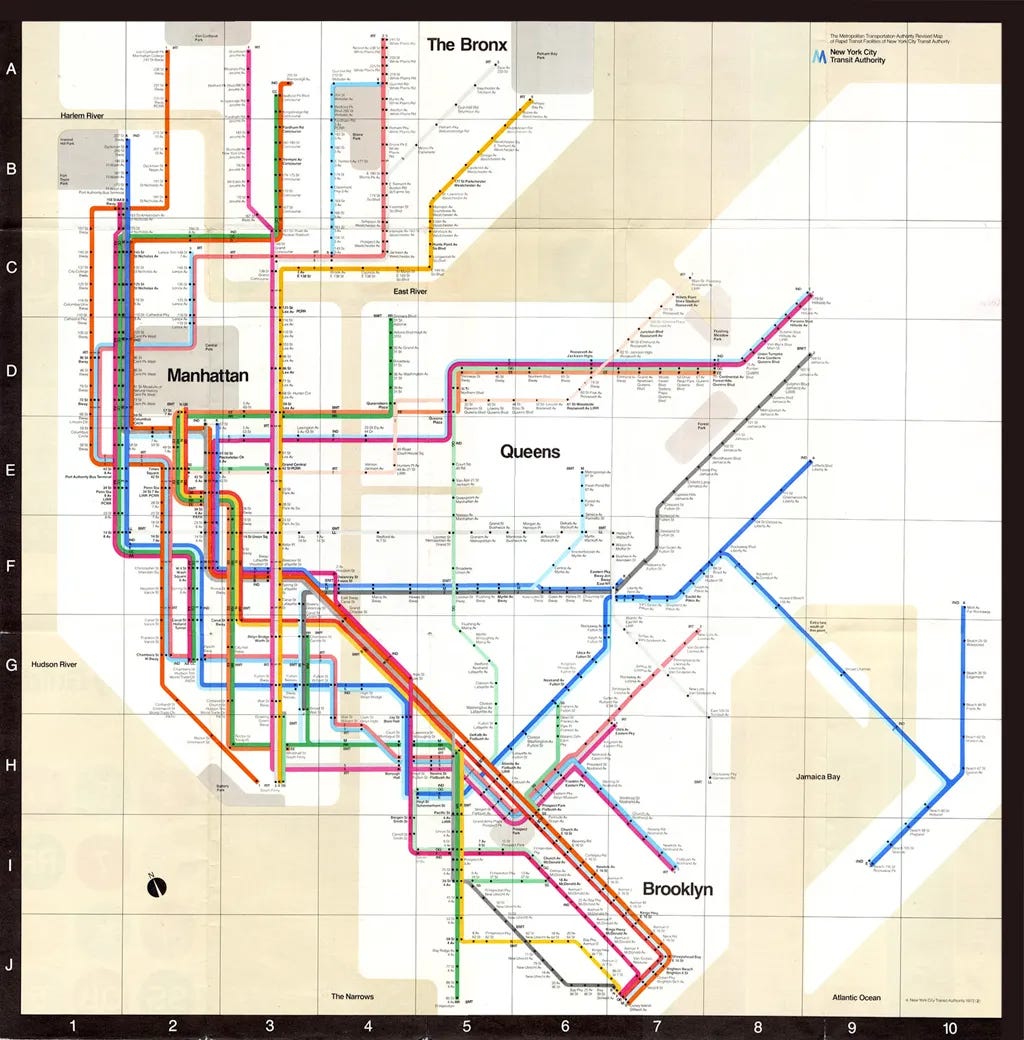
This now iconic 1972 version by the designer Massimo Vignelli hangs in the Museum of Modern Art. Here is what Vignelli said about the map it replaced: “There’s too much information. The greatest thing about the London map, if you’ve ever seen it, is that they stick to the subway, the underground. Therefore, there’s no reference to above. In New York, they wanted to put everything. It was too much.”
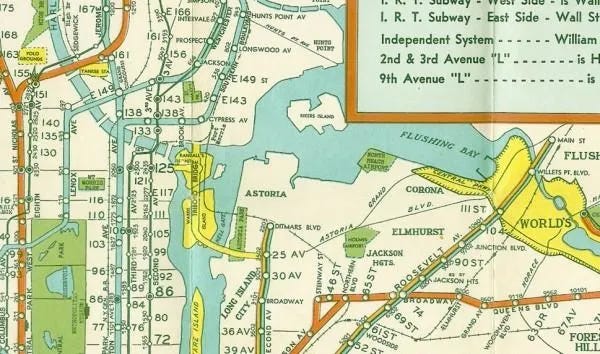
Truth, likewise, needs to be designed for human minds. Sometimes an expression of truth has to be distorted in some dimensions for it to be a useful map of reality. Monsters, gods, and demons are better designed for the human mind than “meme.” Marx knew this; he opened the Communist Manifesto with a ghost. Scott Alexander knew this when he reached for Moloch. My Visayan ancestors knew it when they saw the Bakunawa.
Notice what Vignelli praised in the London map: it sticks to the underground. No reference to above. That omission is the entire reason the map works. Science’s map is the same. It shows what has a membrane, what can be counted, what can be run through the bookkeeping. Its refusal to show anything without a border is not a failure of vision. It is the London map’s refusal to show the streets. You cannot ride the train with a street map, and you cannot build a vaccine with a pantheon.
Animism was one map of what is above: the streets, the cathedrals, the creatures that walk between them and feed on the passengers coming up the stairs. It is true the way a street map is true. It gets you across territory the other map leaves blank, and it will get you killed if you take it down into the tunnels, which is why I don’t want it in the hands of a scientist at work, or an accountant. Neither map is the territory. Both are true. Neither should try to be the other.
There is one more thing a traveler should ask of any map, and it is what separates neo-animism from the animism of my ancestors. Who was it made for?
New Versus Old Animism
Old animism was right about the territory. My ancestors saw the creatures. So did everyone else’s ancestors, until the Cyclopes’ bargain made the creatures invisible to many of us. Neo-animism is not a discovery. It is a recovery of sight. But the old animists made two mistakes, and both are in the maps they drew.
The first mistake is the one I proposed in Part I. Old animism attributed consciousness to these beings. They were gods and egregores, with wills and grudges, who could be spoken to and bargained with. Neo-animism recognizes their agency and intelligence but not their consciousness. Talking to them is like talking to a tiger. This sounds like a philosopher’s quibble. It isn’t. If the serpent is a god, then its hunger is a demand, and demands can be negotiated and satisfied. If it is an animal, its hunger is simply what it is, and the only question is whether you get eaten.
The second difference is in who the map was for. The old map was not wrong. The priestesses of Cebu saw the serpent correctly, and so did the priests of Canaan; they drew it with its real face. But the map was designed for the psychofauna, not for humans, or at least for the benefit of the powerful few at the expense of the many they enslaved. Raid for captives, burn them at the feast, turn the smoke into power. This is what led to animism’s worst derangement, ritual human sacrifice: not that our ancestors saw monsters where there were none, but that they saw them and drew the map from the monster’s side of the altar.
Neo-animism redesigns the map for humans. It is a map drawn for the person holding it, not for the creatures that want the mind reading it.
This is also my last answer to the danger I raised. A map that tells you to feed the creature is what wakes it. A map that shows you the creature and tells you whose side it is on is what I promised Psychofauna Studies would be: a weapon of defense first, and only then, for those who dare, a way to ride these creatures (and to pick the right ones to ride).
What is truth? For a traveler, it is the map that gets you home. This is mine. The invitation from Part I still stands.
For a personal account of what practicing neo-animism looks like in creative work, see How the Diwata Got Me to Write a Feminist Novel Despite Being Steeped in Filipino Machismo.
Claude, give us some examples.
Yes, m’lord.
A record of its design. Biology got there first with the genome, but the trick generalizes. A society’s taboos, myths, and shared identities are a record too, written not in nucleotides but in what feels unthinkable to violate. “We do not eat the totem animal” will outlive every member who currently holds it, the way a codon outlives the cell that reads it. Institutions externalize the record entirely: laws, SOPs, founding myths, traditions kept long after anyone remembers why. A constitution is a genome you can amend. A corporate handbook is a genome you can violate and get fired for. The function is always the same: compress “how to be this thing” into a form that survives the death of any single instantiation.
An ability to vary its design. The variation mechanism tells you a psychofauna’s temperament. Sexual reproduction shuffles genes blindly; premodern societies vary the same way, by taboo drift and ritual mutation, one generation misremembering what the last one meant. Nation-states are the weird case: modernity tries to vary on purpose. A constitutional convention is a designed mutation. So is a five-year plan. Most are worse than blind chance would have produced, which tells you how good we actually are at directing evolution rather than riding it. Corporations split the difference. R&D and quarterly pivots dress variation up as intention, but the market still does the selecting, mercilessly, after the fact.
An ability to rearrange matter to increase the vessel’s odds. Animals hunt and hide; plants bribe insects with nectar. Humans build shelter, but also narrative: propaganda is a nation-state rearranging matter, the matter just happens to be neurons. Technocapital doesn’t hunt or hide. It rewards, paying out dopamine and dollars to whoever expands it fastest, and it does this with no one running it, the way no single cell runs your immune system. That’s the tell of a living psychofauna rather than a metaphorical one. Nobody’s driving, and yet the system unmistakably wants something.
Which, per Hidalgo, is the whole point. Information wants to grow, and it will conscript whatever matter is lying around — atoms, bodies, neurons, capital. Taleb told us how to survive being conscripted. Hidalgo tells us why we keep getting conscripted. Put them together and psychofauna stop being a literary conceit and become the boring consequence of what information does whenever it’s given something fragile to ride.
The angel’s corpse is Henry Corbin’s image: abstract rational thought lives on the dead body of an angel, where the angel is animacy itself — the sense of a world made of persons rather than objects. I first heard it on “Animism is Normative Consciousness,” an episode of Joshua Schrei’s podcast The Emerald, which is where I’d send anyone whose upbringing was Westernized enough that “animism” still sounds like a category from an anthropology textbook. (Paul Colilli wrote an entire book around the image, The Angel’s Corpse, 1999, which Schrei describes as brilliant and nearly unreadable. I have not tested the second claim.) Thanks to Cleo Kearns for leading me towards this podcast episode.
Laura Lee Junker, Raiding, Trading, and Feasting: The Political Economy of Philippine Chiefdoms (University of Hawai'i Press, 1999). Junker reconstructs the prehispanic archipelago from archaeology and from the trade records of everyone who sailed into it, and what emerges is not a society with some unpleasant customs attached but a single machine: raid for captives, convert captives into labor and into destroyable wealth, burn that wealth publicly at a feast, and convert the smoke into rank. Sacrifice is not a footnote to her economics — it is the demand that keeps the raiding profitable. She notes that captives were the most common victims at chiefly feasts and that the system required ever more of them.
Kahlil Corazo, “The Scapegoat Mechanism in Southeast Asian Ritual, Myth, and Politics: From Mead and Bateson’s Trance and Dance in Bali to Massacres in the Philippines and Indonesia,” Contagion: Journal of Violence, Mimesis, and Culture 32 (2025): 67–89, https://doi.org/10.14321/contagion.32.0067. It sits behind an academic paywall, which is its own small illustration of a psychofauna — Academic Industrial Complex, the bastard son of Science and Technocapital — guarding its perimeter. If you lack institutional access and want a copy, write to me at sugbu@corazo.org and I’ll send one.
On the blindness we continue to carry in exchange for unity against Empire, see Filomeno V. Aguilar Jr., José Rizal, Nationhood, and the Anticolonial Imagination (Ateneo de Manila University Press, 2023). I wrote about the book here.
Girard placed the origin of the mechanism inside evolutionary history, and said plainly that he was speaking as a Darwinian in doing so: once the pre-human crossed some threshold of mimetic capacity, the dominance hierarchies that keep other primates from destroying each other stopped working, and what replaced them was the reflex of converging on a single victim. The killing worked, and it kept working. Repeated across a hidden prehistory, it left behind rituals, gods, myths, and the reflex itself, which is still in us and still waits for chaos to wake it. I've unpacked it at more length here.
This sentence is a compression of "The Scapegoat Mechanism in Southeast Asian Ritual, Myth, and Politics," cited above, which walks the same path at length: from a ritual filmed by Mead and Bateson in Bali, through the myths that encode it, to massacres in the Philippines and Indonesia and the strongmen who still find the mechanism reliable.
In "In Defense of Peter Thiel's Anti-Sacrificial Tech Optimism," where I also proposed a cognitive bias I call the sacrificial fallacy: the intuition that everything must have a cost, that no gain arrives without a victim somewhere paying for it. That intuition is the scapegoat mechanism operating at the level of individual cognition rather than the mob, and it is why every new technology is met first with the question of who will be sacrificed for it. I still think the fallacy is real. What I'd revise is the confidence of that essay's conclusion.
Really good stuff.
It’s interesting that Popper could be seen as demythologizing science in a way. The myth of induction allowed scientists to feel like there was a mechanical process by which observation was transmuted into theories. Popper wipes that away, but seems to provide science with a replacement that works as well. On the other hand, maybe there is a reason Popper is not more widely acclaimed.
Also interesting that David Deutsch does take memetics seriously. Though perhaps there’s a limitation even here.